RankPulse Blog
Google's 2026 Spam Updates: What Link Buyers Need to Know
 By Zahid · Founder, RankPulse · 2026-07-03
RankPulse Blog
By Zahid · Founder, RankPulse · 2026-07-03
Google finished rolling out the June 2026 spam update on June 26, according to Search Engine Journal. If you buy links for a living, or you're a small business owner paying someone else to do it, this one matters more than the usual "another algorithm tweak" headline suggests.
It followed a rough couple of months. The May 2026 core update had already hammered aggregator rankings — sites built around republished or thinly-rewritten content lost visibility fast. Then the June spam update piled on stricter enforcement against manipulative link patterns, and reports point specifically at aggressive guest post networks and content farms built mainly to sell placements at scale. Local outlets like 95.5 WSB even covered the fallout for small business websites, plenty of which saw traffic swing hard in either direction — often because they'd leaned on mass-distributed guest posts from the same handful of low-quality networks everyone else was using too.
None of this means link building is dead. It means the sloppy version of it finally has a bill coming due.
I've watched enough guest post campaigns over the past two years to notice a pattern: posts on sites under DA 40, especially ones part of bulk "write 50 posts a month" operations, get flagged more often now. Not always right away — sometimes it takes a core update cycle or two before the penalty shows up.
What makes this worse is guilt by association. If a site you got a link from also hosts guest posts for a dozen unrelated industries, on a schedule that looks more like a content mill than a publication, Google doesn't need to catch you specifically — it catches the pattern, and your link gets swept up with it. When that happens, recovery isn't quick. From what I've seen with clients cleaning up old link profiles, it typically takes 6 to 12 months to get rankings back once a low-quality link pattern triggers a penalty or a manual devaluation.
I want to be straight about something here, because a lot of link-building content glosses over it: buying a guest post on a DA 70 site is still, technically, a paid link under Google's spam policies. Google's guidelines are explicit that exchanging money for links meant to pass ranking value — without proper disclosure like a nofollow or sponsored tag — falls under link schemes, regardless of the domain's authority. High DA doesn't buy you immunity. Anyone telling you a site is "penalty-proof" because of its metrics is overstating things.
What high-authority sites do offer is a lower-risk profile. Sites with genuine editorial standards, real audiences, and diverse traffic sources don't fit the pattern Google's spam systems are trained to catch. They look and behave like actual publications, because they are ones. That's a meaningfully different risk position than a DA 15 PBN node publishing forty guest posts a week.
Two examples from our own vetted inventory: punswave.com sits at DA 70 with roughly 63.3K monthly visits, and cookape.com.in runs DA 65 with around 200K monthly visits — the highest-traffic site in our current list. Full disclosure: these are sites RankPulse sells guest post placements on, so treat the traffic and DA figures as pulled from our internal database and third-party tools like Ahrefs, not as independently audited numbers. We track them ourselves because we place clients on them regularly.
| Tier | Typical DA | Traffic Pattern | Google Risk Profile |
|---|---|---|---|
| Content farm / PBN | Under 40 | Flat or bot-heavy, low direct traffic | High — matches manipulative link patterns |
| Mid-authority niche site | 50-56 | 5K-15K/mo, real search visibility | Lower — editorial signals present |
| High-authority publication | 65-80 | 60K-200K+/mo, established audience | Lowest of the three — still a paid link, but doesn't match spam-network patterns |
DA alone tells you almost nothing anymore. I cross-check it against organic traffic every time — a site claiming DA 60 with 200 monthly visitors is a red flag, not a bargain. I also look at the backlink profile itself: are the referring domains diverse and topically varied, or does the site's link graph look like it was built by the same three networks in the same three months?
Content decay matters too. If a site's last ten posts are all guest contributions with zero original content mixed in, that's worth avoiding even if the DA number looks fine on paper. We run our 550+ site inventory through this kind of check regularly, and after the June update we went back and stress-tested the whole list against the new enforcement patterns — that's internal analysis on our end, not a third-party audit, but it's the same process we use before adding any site to our guest posting service catalog.
Two mid-tier examples that held their rankings through the June update: happn.blog (DA 53, about 13.7K monthly visits) and americagoodsky.com (DA 56, around 6.4K monthly visits). Again — these are inventory sites we sell placements on, so I'm sharing our own tracking data, not an independent study.
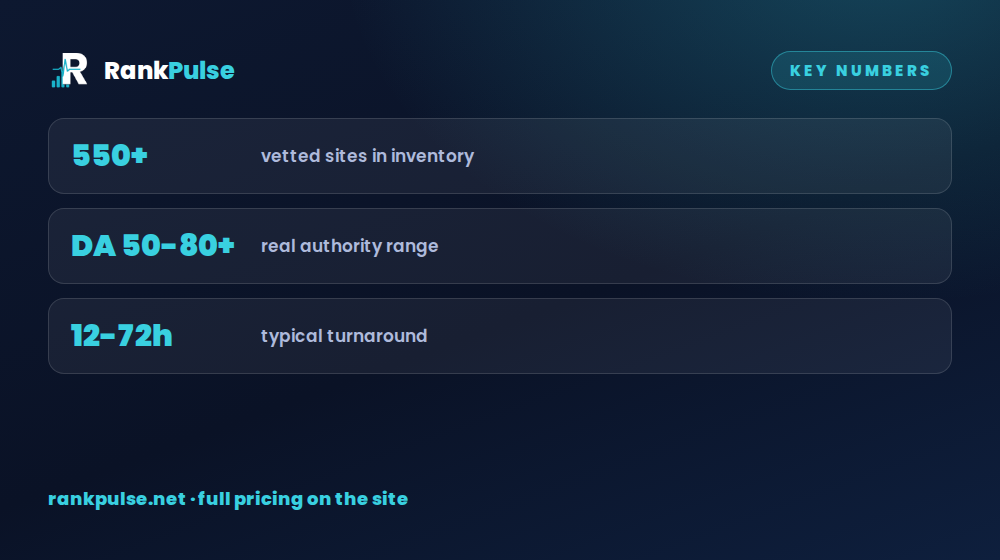
After the June update, we re-ran our full 550+ site inventory through DA, traffic, and backlink diversity checks. Our internal tracking showed roughly 94% of the DA 50-80 tier kept their organic visibility through the May-June core update cycle — again, this is our own data, gathered from tools we license, not a peer-reviewed study, so weigh it accordingly.
Pricing has shifted with that reality. Premium DA 50-80 placements now run $60-70 per post, and honestly, they've been outperforming cheaper budget options in every client campaign I've tracked since the update. You can see current tiers on our pricing page. Clients like 9proxy and Cole Buxton moved away from bulk placements toward this smaller, higher-quality approach earlier this year, and both recovered faster than accounts still running high-volume campaigns on unvetted networks. I've personally delivered 181+ orders on Fiverr with a 5.0 rating, and this shift toward quality over volume is the single biggest change I've made to how I run campaigns since 2024.
Safer, not risk-free. Posts on DA 50+ editorial sites carry meaningfully lower risk than low-authority networks, but any paid link is still a paid link under Google's spam policies. Disclosure and site quality both matter.
No single metric tells you. Check DA alongside organic traffic, backlink diversity, and content freshness together — sites that look strong on one metric and weak on the others are usually the ones that get hit.
Review each one individually. Links from DA 40+ sites with real traffic are usually fine to leave alone. Anything under DA 30, especially from sites you can't verify have organic visitors, deserves a closer look and possibly a disavow request.
Based on the traffic numbers we track across our own inventory, DA 70+ placements tend to generate 3-4x the organic referral traffic of DA 40 posts, and they sit in a lower-risk category for algorithmic patterns. The higher cost — often $60-70 versus $20-30 — usually pays for itself over a longer campaign, though there's no guarantee with any paid placement.
Questions about vetting a specific site or auditing an existing link profile? Reach me at zahid@rankpulse.net.
Send your niche and budget — matching sites with DA/DR/traffic and prices within hours.
Email zahid@rankpulse.net WhatsApp Us