RankPulse Blog
Internal Linking: Maximize Ranking Value from Existing Links
Your Backlinks Are Sitting Idle (And Costing You Rankings)
You paid for a link. It showed up on a relevant site with decent traffic. Google found it, your domain authority ticked up a bit, maybe you got some traffic from it. Then nothing. Most sites treat that link like a one-time win: the job's done, move on. Meanwhile, that link's ranking power sits mostly untapped because you never connected it to the pages that actually need help.
This is the gap between owning a link and using it. It's the difference between buying an asset and putting it to work.
- A single external backlink can pass its ranking power through internal links to pages buried deeper in your site.
- Across a 550-site sample, the median domain rating is 63 (Ahrefs), with 37% of sites at DR 70 or higher.
- Pages with no internal link path from your power pages are effectively invisible to Google's crawlers, no matter how good your backlinks are.
- A tiered internal linking strategy from high-equity pages to target pages can move rankings on commercial pages that aren't getting traffic yet.
Why Backlink Value Decays Without Internal Strategy
I've seen this play out dozens of times: a client gets a backlink placed on a real site. The link is dofollow, relevant, and from a domain with actual traffic. By every measure, it's a good link. But it's pointing to the homepage, and the page that actually needs ranking help is three clicks deep with no internal links connecting them.
Google's crawlers find the link and recognize the domain boost. Your site's overall authority goes up a notch. But that authority doesn't flow where you need it.
The fix is straightforward. You need a clear path from your high-equity pages to your target pages. A backlink pointing to your homepage that isn't internally linked to your product comparison page is like cash locked in a vault.
Understanding Link Equity and How It Flows
Link equity (what some call PageRank) is the ranking signal that moves through links. External backlinks bring equity into your site. Internal links distribute it. Google's own documentation on link qualification makes clear that dofollow links pass ranking credit. Paid links that pass ranking credit without proper rel attributes can be treated as link spam.
That's worth stating directly: if you've bought links, they should carry rel="sponsored" or rel="nofollow" tags, or they exist in a gray area both legally and practically.
Here's what most people miss: even with correctly tagged backlinks, the internal links connecting your own pages are yours to control. There's no policy restriction on how you structure them. If a page with strong external backlinks has no internal link to a target page, that link equity never reaches it.
One more layer: Google weighs where an internal link sits. A link in the main content carries more weight than a link in the footer. A link from a page with existing authority carries more weight than a link from a new page. Placement and source matter just as much as whether the link exists.
Identifying Your Power Pages and Target Pages
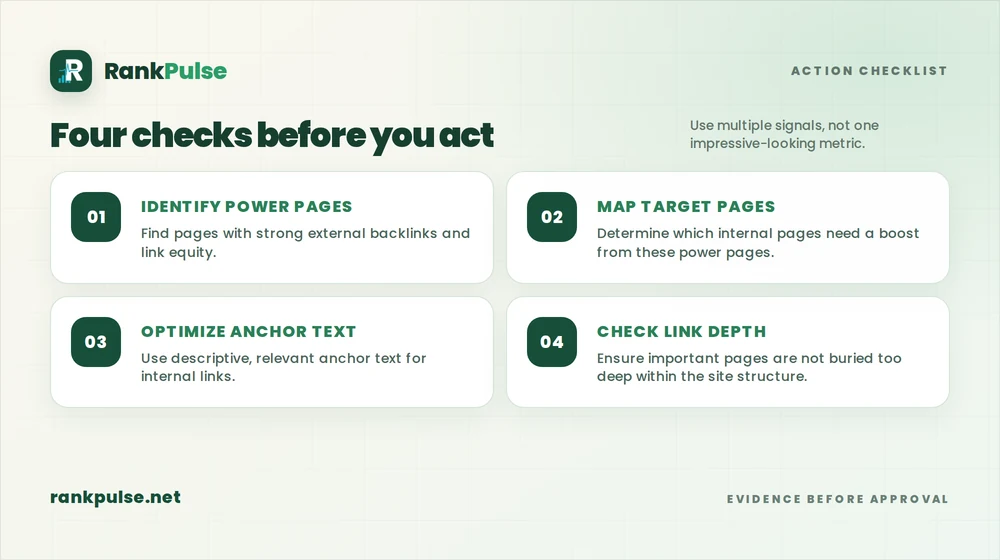
Start by finding which pages on your site have the most external backlinks.
Pull a list of all your pages with referring domains using Ahrefs, SEMrush, or Moz. Rank them by domain rating or domain authority. Your homepage almost always comes out on top, but look for any page with multiple quality backlinks or links from high-authority sources. These are your power pages, the ones with external link equity flowing into them. Now ask: are these the pages I actually want to rank for?
Often the answer is no. You might have a strong homepage but you're trying to rank for product comparisons, pricing, case studies, or niche keywords. Those target pages exist and have traffic potential. They just don't have backlinks yet.
That's where internal linking steps in. Your power pages become the hub for distributing the ranking equity your backlinks brought in.
Building an Internal Link Strategy Around Your Backlinks
The concept is simple. The execution takes real work.
Map your backlinks and identify which pages have multiple external backlinks or links from high-authority sites. These become distribution hubs. Then map your target pages: the ones you want to rank for commercial or high-intent keywords but that have no strong backlink profile yet. Draw internal links from your power pages to your target pages using descriptive anchor text that matches the target page's intended keyword.
Here's a concrete example: You have a homepage with 15 quality backlinks. You want to rank your pricing page for "SaaS pricing comparison." Add an internal link from your homepage to your pricing page and anchor it with "SaaS pricing comparison" or "compare plans." That anchor text reinforces the keyword relevance on the target page, and the link itself carries equity from the homepage's backlink profile.
It works because Google traces the equity path: external link comes into your homepage, internal link flows from homepage to pricing page, so the pricing page inherits some of the homepage's ranking power for that keyword.
The impact multiplies when you have multiple power pages. If your homepage links to a pillar page, and that pillar page links to three cluster pages, equity flows through the hierarchy. The page furthest down gets less than the one at the top, but it still gets something.
Anchor Text, Placement, and Link Depth Matter
Three details that change results.
Anchor text: Use actual keyword phrases, not generic "click here" or "learn more." If your target page is about "content marketing tools," use anchor text like "best content marketing tools" or "content marketing software." This tells Google what the target page covers. Brand-safe variations work too. Avoid over-optimization: if all your internal anchor text matches one exact keyword, it looks artificial.
Placement: A link in the main body copy carries more weight than a link in the sidebar or footer. Most sites stuff internal links into footers and wonder why rankings don't move. If a page deserves a link, weave it into the content where readers see it. It's also better for user experience, which Google notices.
Link depth: Every click from your homepage to a page increases that page's depth. Your homepage is depth 0. A page linked from the homepage is depth 1. A page linked only from a depth-1 page is depth 2. Pages at depth 3 or deeper are harder for Google to crawl and rank. Keep important target pages within two or three clicks of your homepage. A page at depth 5 with no internal links pointing to it has almost no chance of ranking.
Auditing Your Current Internal Link Structure
You probably have internal links already. Most sites do. The question is whether they're actually working for you.
Run a site audit from Screaming Frog, Semrush, or Ahrefs and look for "orphan pages": pages with little or no internal link equity flowing to them. In most audits, 10% to 30% of pages have fewer than three internal links pointing to them. Those pages are competing for rankings with almost no internal support.
Also find pages with high traffic potential or high keyword potential that don't have links from your power pages. These are quick wins. A single internal link from a high-authority page to a target page can shift rankings within weeks if the rest is solid.
Check your internal link distribution. Does your homepage link to your most important pages, or does it link to every page equally? A focused structure where the homepage links to 8 to 15 key pages (your main categories, pillar pages, highest-intent offers) distributes authority more efficiently than a site where the homepage links to 200 pages.
Use Ahrefs or SEMrush to visualize internal link flow. Look for pages that should have higher authority but don't because they're poorly connected. Fixing those connections is free and can move rankings.
Connecting Paid Links to Rankings Through Internal Structure
This is where it gets real: taking the backlinks you paid for and making them actually rank your target pages.
Say you've invested in a guest posting campaign across three or four sites. Each post is dofollow, relevant, and from a domain with real traffic. You're now getting 3 to 4 new quality backlinks, and most are probably pointing to your homepage or a broad category page by default.
Do this: audit which target pages (the ones you're trying to rank for specific keywords) are receiving no internal links from your power pages. Add those internal links using anchor text that matches the keywords those target pages need to rank for.
You've created a link equity chain. The backlink brings authority into your site. The internal link carries that authority to the page that's supposed to rank. Within 4 to 8 weeks, you'll often see ranking movement for those pages, especially for keywords with moderate competition.
This works best when your internal link strategy is deliberate. One or two random internal links won't move the needle. A thoughtful network where multiple power pages link to your target pages with keyword-aligned anchor text creates a ranking signal that's hard to ignore.
What Good Backlinks Look Like (And Why Vetting Matters)
Before you can distribute authority, you need authority worth distributing.
A low-quality backlink won't help your internal linking strategy because there's no equity to distribute. A link from a private blog network, a keyword-stuffed directory, or a domain with no real traffic doesn't pass meaningful ranking signal, no matter how many internal links you add.
When you're evaluating a placement before paying, check three things. First, domain rating or authority (aim for at least 50+). Second, traffic indicators: some evidence the site gets real visitors, visible in tools like Semrush or Ahrefs. Third, relevance: the site's audience or topic should match your industry. A link from a relevant DR 60 site beats a high-authority link from an unrelated niche.
Across a 550-site sample, the median domain rating is 63 (Ahrefs), with 37% of sites at DR 70 or higher. That vetting difference is what separates a link that moves rankings from a link that costs money and delivers nothing.
Monitoring and Refining Your Internal Link Strategy
Changes take time. Wait 4 to 8 weeks after you build internal links from power pages to target pages before evaluating impact.
Track two things: rankings for your target keywords (use Google Search Console, Ahrefs, or SEMrush to monitor position over time) and traffic to those target pages (track in Google Analytics). A successful internal linking change shows two signals: keyword positions rising gradually, and traffic following a few weeks later.
If you don't see movement after 8 weeks, audit the link. Is it actually there? Is the anchor text relevant? Is the target page technically sound with no crawl errors and solid on-page SEO? Often the internal link alone won't move rankings if the page has poor on-page work or if the keyword is highly competitive. But in moderate-competition spaces, a well-structured internal link from an authority page usually works.
Refresh your audit every quarter. As your site grows and you add new backlinks, you'll have new power pages. Add internal links from those to your strategic target pages. The structure compounds over time.
FAQs: Getting More Ranking Value from Your Links
How often should I audit my internal links?
Run a full audit every quarter using a crawler like Screaming Frog or SEMrush to map your internal structure and identify orphan pages or target pages with weak link profiles. Monthly spot-checks are fine for verifying whether your recent internal link additions are live.
Can internal linking help pages that aren't ranking at all?
Yes, if the page itself is solid. Internal links help pages rank better for keywords they already have on-page signals for in the title, headers, and content. If a page has no keyword content at all, no internal link will fix it. But if you've written good content and Google's indexed the page but it's at position 50 or lower, a strong internal link from an authority page often moves it to page two or one within weeks.
What if my backlinks are from sites below DR 50?
Lower-authority backlinks still pass some signal, but the gains are modest. If you've already acquired lower-authority links, internal linking can still offer some benefit, but the most significant gains from this strategy come from links with stronger foundational authority. Focus on acquiring backlinks from higher-authority sites first, then use internal linking to multiply their value.
Disclosure: RankPulse sells placements across vetted publisher sites. RankPulse ensures that placements it facilitates include proper attribution via rel="sponsored" or rel="nofollow" where applicable.

Level 2 Fiverr seller with a 5.0 rating. Has reviewed thousands of publisher records to build a curated placement inventory since 2024. Fiverr profile · zahid@rankpulse.net