RankPulse Blog
PBNs & Google's Spam Updates: Are They Still Worth It?
The Allure and Peril of PBNs: A Retrospective
You bought links last year that promised DA 60+ and a "lower-risk ranking boost." Six months later your traffic flatlined, or you landed a manual action notice out of nowhere. If that's your story, you've probably tangled with PBNs and didn't even know it.
- Vet traffic, relevance, anchors, and publisher policy before buying any placement.
- RankPulse data: 37% of inventory has DR 70+.
- Paid links carry policy risk when they pass ranking credit without proper disclosure.
Data note: For Google policy or update references, this article uses Google documentation and treats unsupported update-target claims as audit guidance, not confirmed targeting. This article cites data from a review of 550 unique domains in our internal placement inventory and publicly available traffic metrics where noted.
A Private Blog Network is a collection of websites, often dozens or hundreds, built or bought by one person or agency purely to link out to client sites. They look independent on the surface: different domains, different themes, sometimes even different hosting providers on paper. The appeal was straightforward. You could theoretically control your entire link profile, choosing anchor text, link velocity, and topical relevance with precision. No negotiations with real editors. No waiting for placement. No editorial rejection.
The fundamental flaw ran much deeper than it first appeared. PageRank, Google's original algorithm, rewarded links as votes of confidence. PBNs attempted to game this system by creating artificial votes. Google's entire link-evaluation framework evolved specifically to detect and discount these manipulative patterns. When you own the network, Google's systems eventually recognize it.
For years, some PBN operators claimed they could hide these patterns through careful IP masking, hosting dispersion, and aged domains. That window has closed. Google's detection capabilities have expanded dramatically, and the cost of being caught now vastly outweighs any short-term ranking gains.
Google's Intensified Crackdown on Link Spam
Google has intensified its focus on spam detection and link manipulation. Recent industry reports indicate Google is deploying targeted spam-focused updates at an accelerated pace, signaling a major shift in enforcement strategy.
The frequency and scope of these updates signal a shift in Google's strategy. Rather than occasional, broad core updates that catch spam as a side effect, Google is now deploying targeted spam-focused rollouts. This means detection algorithms are improving in real time, and sites relying on manipulative link schemes face heightened risk with each update cycle.
Google's spam policies explicitly define link spam as any link intended primarily to manipulate PageRank or search rankings. This includes links from PBNs, regardless of how well they're disguised. Google's systems now flag interconnected ownership patterns, unnatural linking velocity, and topical irrelevance as spam signals.
For sites relying on PBN links, the impact has been severe. Manual penalties result in immediate visibility loss. Algorithmic devaluations quietly suppress rankings without a notice in Google Search Console. Recovery requires disavowing the bad links, rebuilding with legitimate placements, and waiting for Google to recrawl and reassess, a process that can take months or years.
Identifying PBNs: Red Flags to Watch For
Before you buy another link, learn to spot the warning signs. Real editorial sites have measurable organic traffic from a genuine audience. PBNs often show zero or negligible traffic because they exist only to pass links. Check Semrush, Ahrefs, or SimilarWeb for traffic reports. If a site claims DA 50+ but shows almost no monthly visitors, that's a red flag.
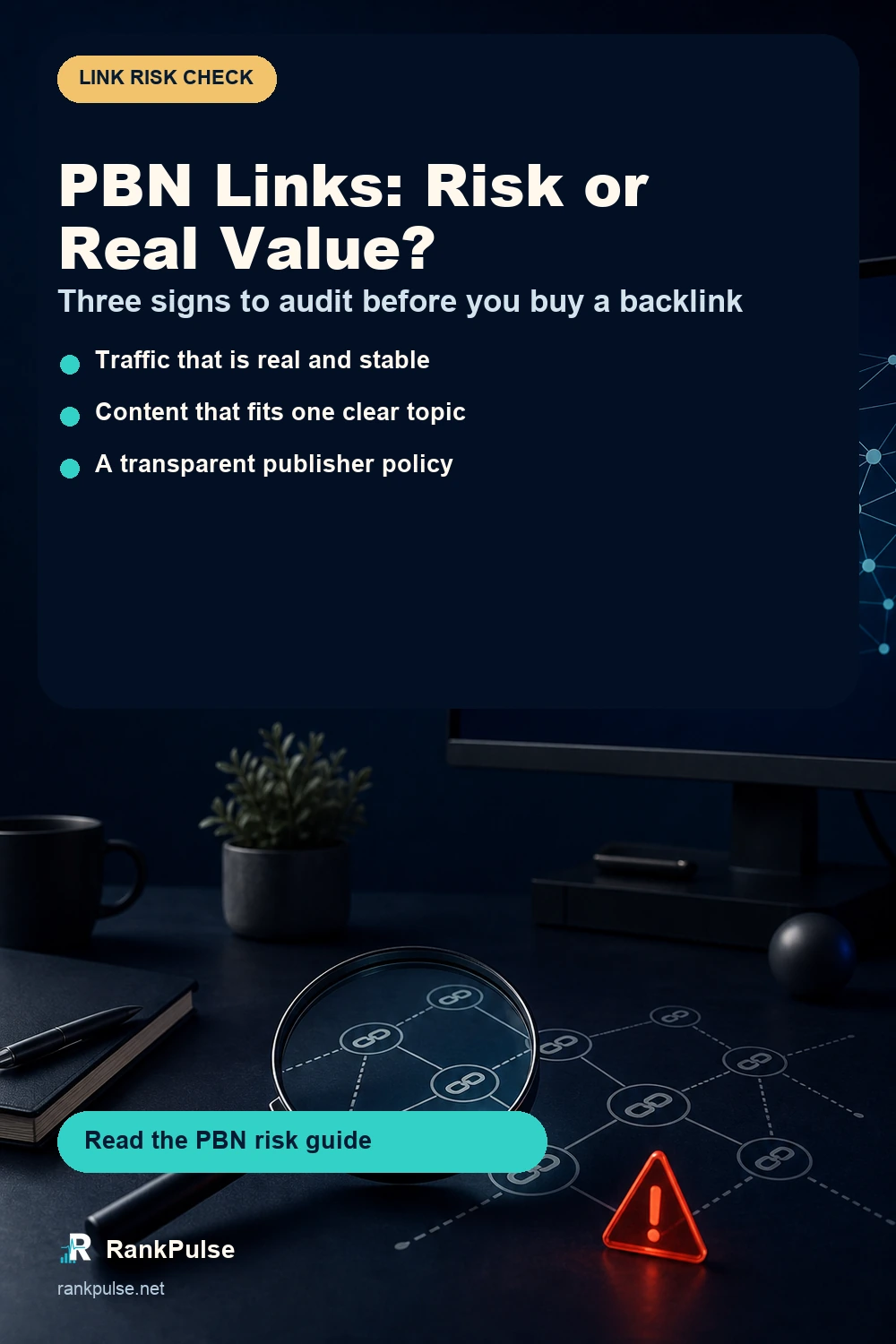
Content quality and topical focus tell you a lot. Editorial sites maintain consistent themes and publish regularly. PBNs often have scattered, incoherent content or sudden topic shifts that align suspiciously with whatever niche the link seller is pushing that month. Look at the archive to see whether the site has a coherent editorial voice or jumps from cryptocurrency to fitness to legal services.
Ownership patterns are the clearest signal. Use WHOIS lookup, hosting databases, and IP trackers to check whether the site shares registration details, nameservers, or IP addresses with other sites. Unique ownership is the norm for real editorial sites. Clusters of sites with identical or near-identical administrative information are a hallmark of PBN infrastructure.
Anchor text and link patterns matter too. Real editors link contextually and diversify anchor text naturally. PBNs often show over-optimized anchor text pointing directly to money keywords, with multiple links per page or identical anchor-text patterns across the network. This screams manipulation to both human reviewers and algorithmic detectors.
Why the Risk Outweighs the Reward Now More Than Ever
Google's detection capabilities have improved exponentially. Machine learning models now identify PBN characteristics faster than manual review teams ever could. A site you bought links from six months ago might be fully identified and devalued by next month.
The penalty structure is brutal. A manual action can wipe out 80–90% of your organic visibility in a single day. Algorithmic penalties are subtler but just as damaging. Even if you disavow the bad links immediately, recovery takes time. Meanwhile, your competitors using legitimate link-building strategies are passing you.
The math no longer works. A PBN link that costs $50–$200 might deliver a ranking boost for three to six months. When Google catches the network, the penalty can cost you thousands in lost revenue, recovery work, and opportunity cost. Real editorial placements from vetted publishers may cost more upfront, but they don't evaporate overnight.
The difference between manipulative links and genuine editorial placements is real traffic and editorial intent. An editorial link comes with referral traffic, brand exposure, and context that signals legitimacy to Google. A PBN link passes anchor text and supposed PageRank to your site while adding no value to readers.
Building a Resilient Link Profile: The RankPulse Approach
If PBNs are too risky, what should you build instead? Start with authoritative, high-traffic publishers. Sites like TheSouthAfrican.com (2.9M monthly visitors), Herald-Dispatch.com (116K monthly visitors), and iLounge.com (118K monthly visitors) offer real editorial placements with genuine audience reach.
Transparent metrics matter. Across our internal placement inventory of 550 unique domains, the median DA is 49 (Moz) and median DR is 63 (Ahrefs) — both widely understood third-party proxies for site authority. While 37% of our inventory has DR 70+, making high-authority placements accessible, 83% of our overall inventory is priced at $100 or less to accommodate various budget levels. These are real editorial sites with measurable traffic, not PBNs masquerading as publishers.
What makes these real editorial sites? They have stable, verifiable organic traffic from a genuine audience. Their content aligns with their niche and editorial standards. They disclose sponsored content where required. They maintain independent ownership and diverse backlink profiles. They don't sell links in bulk to unrelated niches.
Real traffic is a powerful SEO signal and a tangible benefit you can't get from PBNs. When readers click through your link and spend time on the publisher's site, Google registers that as a vote of confidence. You also gain brand exposure to a real audience, potential customers, not bot traffic. This compound value is what separates legitimate link building from manipulation.
Consider lower-risk alternatives like guest posting and digital PR. Guest posts allow you to write valuable content for relevant publications, adding your byline and expertise to established platforms. Digital PR builds relationships with journalists and editors, generating earned media coverage that Google trusts inherently.

FAQs on Link Building Risk & Google Updates
How do I know if I've purchased PBN links?
Run a traffic check on each referring domain using Semrush, Ahrefs, or SimilarWeb. If the site claims high authority but shows zero or near-zero organic traffic, it's likely a PBN. Check WHOIS and IP databases for ownership clustering. Look for over-optimized anchor text and irrelevant content. If a vendor refuses to disclose the live domain before payment, that's a strong warning sign. Real publishers are transparent about their sites because they have nothing to hide.
What should I do if my site has PBN links?
First, audit your backlink profile using Google Search Console and a third-party tool. Identify the suspicious domains using the red flags above. Create a comprehensive list of PBN domains and domains you suspect. Use Google's disavow tool to submit the list. Be thorough, as a partial disavowal leaves you exposed.
Monitor your rankings and traffic for 4–6 weeks. If you see no recovery, consider requesting reconsideration via Google Search Console. Going forward, rebuild your link profile using vetted, legitimate publishers. The faster you disassociate from the bad links, the faster you can recover.
Is all paid link building considered spam by Google?
No, but it must be disclosed. Google's policy is clear: any link intended to pass ranking credit should be qualified with rel="sponsored" or rel="nofollow". When a publisher properly marks a paid link, Google doesn't count it toward rankings, but the placement still generates referral traffic and brand value. The spam violation occurs when paid links are disguised as editorial endorsements. A vendor who refuses to mark links as sponsored or disclose the paid arrangement is running a spam operation.
How can I ensure my link building is compliant with Google's guidelines?
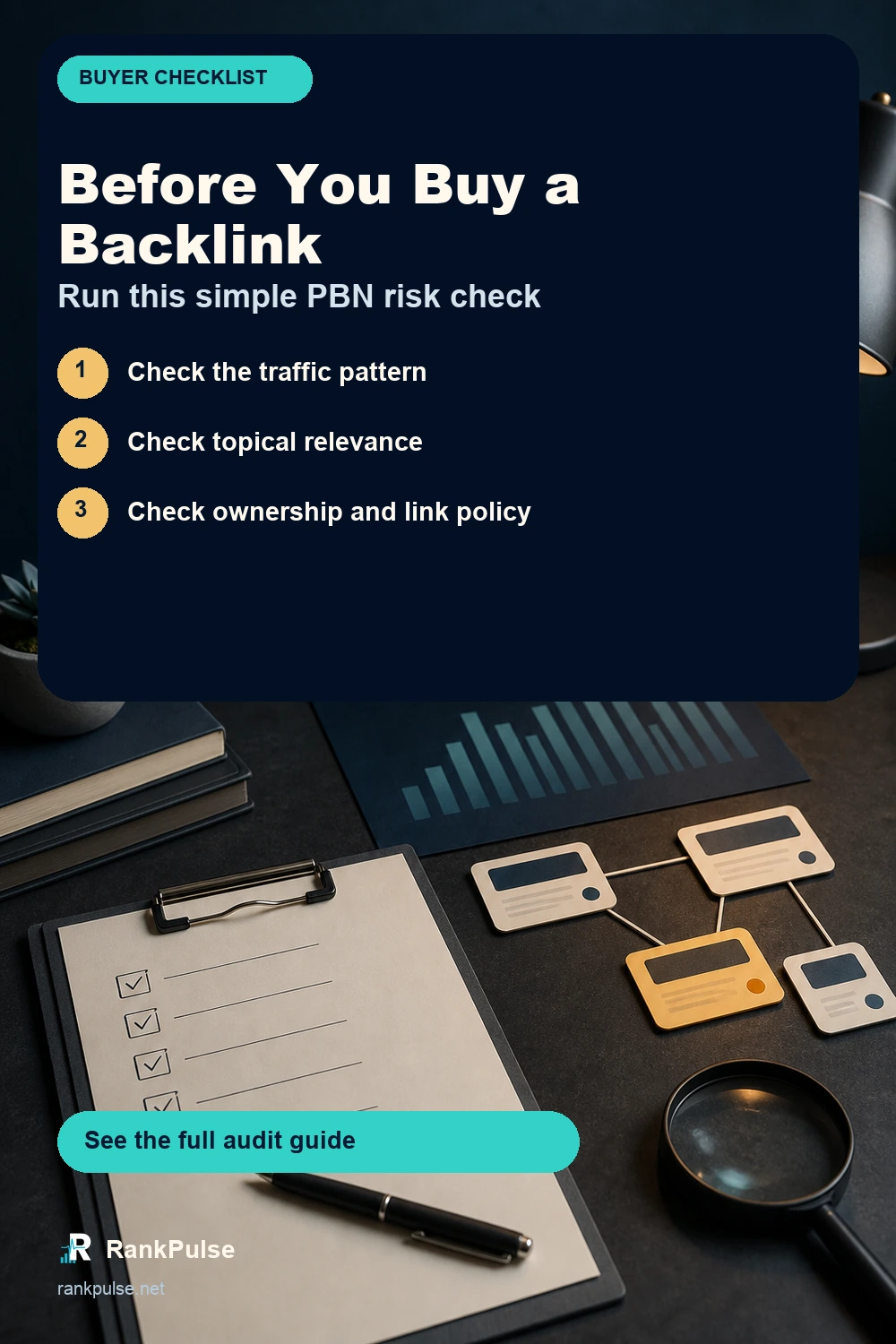
Ask your vendor to confirm they will qualify all paid links with rel="sponsored" or rel="nofollow" where appropriate. Verify that the publisher has a written content disclosure policy. Check that the site has real, stable traffic and independent ownership. Demand sample URLs from past placements and verify their quality.
Look for diversity in your anchor text and referring domains. Avoid vendors who promise rankings or offer links in unrelated niches. Build links gradually, not in large spikes. Focus on relevance, editorial quality, and audience fit. These practices align with Google's guidelines and protect you from future penalties.
The Path Forward
PBNs are no longer a viable shortcut. Google's ongoing crackdown on link manipulation proves the company is serious about eliminating these schemes at scale. The risk of penalties now dramatically outweighs any temporary ranking gains.
If you've lost money to PBN links, you're not alone. The solution is to move forward with vetted, legitimate publishers. Real editorial placements cost more upfront, but they deliver sustained rankings, referral traffic, and brand exposure that PBNs never could.
Ready to rebuild your link profile the right way? Explore our guest posting service and see how real editorial placements can strengthen your SEO strategy without the risk.

Level 2 Fiverr seller with a 5.0 rating. Has reviewed thousands of publisher records to build a curated placement inventory since 2024. Fiverr profile · zahid@rankpulse.net