RankPulse Blog
How to Vet Guest Post Sites Before You Buy
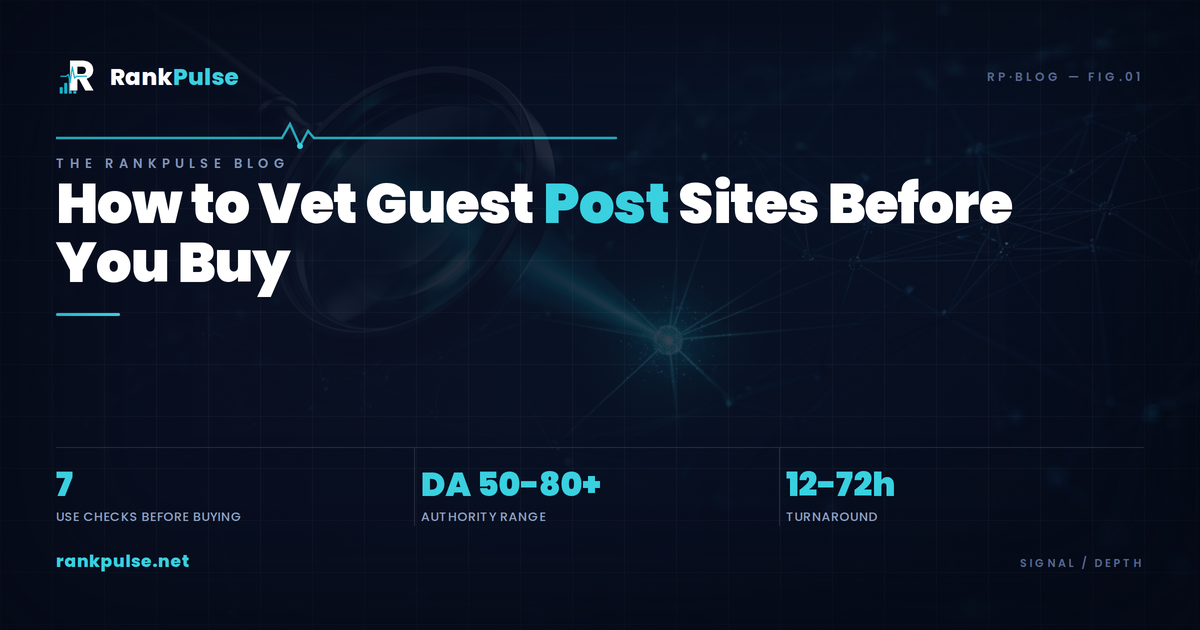
Most bad guest post buys do not look bad at the start. The domain has a decent DA score, the seller replies quickly, and the price feels low enough to test. The problem shows up later, when the page has no traffic, the article sits beside unrelated links, or the publisher quietly edits the placement after delivery.
- Vet traffic, relevance, outbound links, and publisher policy before approving a site.
- DA and DR help you filter options, but they do not prove a placement is worth buying.
- RankPulse tracks a curated placement inventory built from thousands of reviewed publisher records, but each order still gets a manual shortlist.
- Paid links can carry policy risk when they pass ranking credit without proper qualification.
Source note: For paid-link policy, this guide follows Google's guidance on qualifying outbound links. RankPulse inventory numbers are from our own tracking, not an independent industry study. For service details, see our guest posting service and transparent pricing pages.
Start With Traffic, Not Just DA
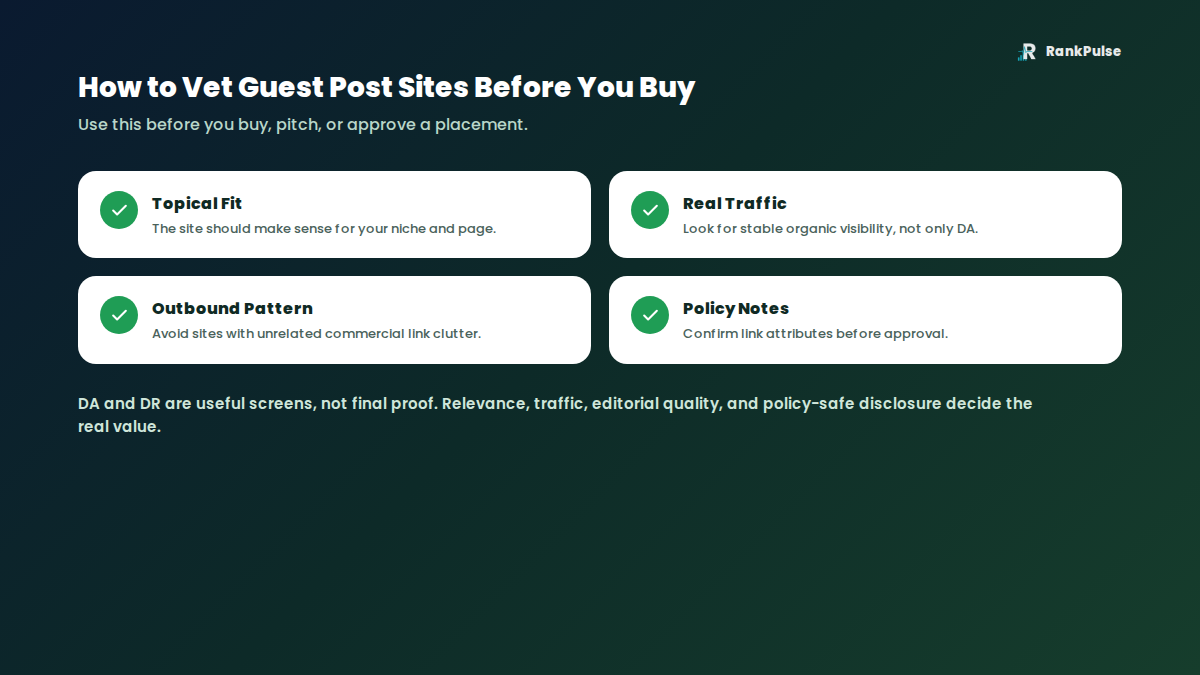
DA and DR are useful filters, but they are third-party scores. A site can have a strong metric and still have weak organic visibility, thin content, or an outbound-link pattern that makes buyers nervous. Before you approve a placement, ask for estimated organic traffic and check whether that traffic looks stable.
A healthy site usually has rankings across more than one page and topic. A weak seller often shows one strong metric and avoids the traffic question. That is the first sign to slow down.
Check Topical Fit Before Price
A cheap placement is not automatically bad, and an expensive one is not automatically better. The first real question is whether the site makes sense for your niche. A SaaS link belongs on a business, software, marketing, or technology site, not on a general blog that publishes every topic under the sun.
Topical fit also affects anchor choice. If the article topic feels natural, the link can sit inside the content without looking forced. If the topic is unrelated, even a branded anchor can look like a paid insertion.
Review the Outbound Link Pattern
Open a few recent articles before buying. Look for repeated commercial anchors, unrelated casino or adult links, thin AI-style posts, and author pages with no real editorial identity. One questionable article is not always a deal breaker, but a pattern tells you how the publisher treats its site.
This is where many spreadsheet sellers fail. They sell the metric, not the page environment. Buyers need to inspect the page environment because that is where the link actually lives.
Ask About Link Attributes Up Front
Do not assume every publisher allows the same link attributes. This is one reason buyers should compare options before ordering, especially if they are choosing between a new article placement and an existing-page insertion such as a link-building audit workflow. Some publishers allow do-follow links, some require sponsored or nofollow attributes, and some change policy depending on the article type. You should know the policy before you pay.
Google's guidance says paid links should be qualified where appropriate with attributes such as sponsored or nofollow. RankPulse positions vetting around relevance, traffic checks, publisher policy transparency, and reporting, not promises that paid links are without risk.
Compare the Deliverables
| Check | Weak Seller | Better Process |
|---|---|---|
| Site metrics | Only DA shown | DA, DR, traffic, niche, and price shown together |
| Publisher policy | Explained after payment | Disclosed before approval |
| Content | Generic article with forced anchor | Topic matched to the site and target page |
| Reporting | Screenshot only | Live URL, metrics, anchor, and replacement terms |
Use a Simple Approval Checklist
Before you approve a guest post site, check seven things: topical relevance, organic traffic, DA, DR, article quality, outbound-link pattern, and publisher policy. If one area is weak, the placement might still be usable. If three or four are weak, skip it.
This is the same reason RankPulse does not send raw domain lists as a final recommendation. A shortlist should explain why a site fits the buyer's page, budget, and risk tolerance.
What RankPulse Checks Before Shortlisting a Site
Our first pass removes sites that look wrong for the buyer's niche, even when the surface metrics look attractive. That includes domains with thin articles, unrelated outbound links, unclear editorial standards, or publisher policies that are not explained before approval. A buyer should never need to guess what kind of link they are buying.
The second pass is more practical: price, turnaround, content fit, and reporting. If two sites have similar authority metrics, the better choice is usually the one with cleaner topical relevance, clearer traffic history, and a publisher process that will not surprise the buyer after payment.
Red Flags That Should Pause the Order
Pause the order if the seller refuses to show the domain, only talks about DA, or says every placement is automatically safe. Also be careful when a site publishes unrelated topics every day, has no visible authors, or uses the same commercial anchor style across many posts.
None of these checks require a complicated audit. Open recent posts, check the site's organic visibility, inspect the article categories, and ask for the publisher policy before payment. If the seller cannot answer basic questions, the placement probably does not belong in a serious link plan.
FAQ
What is a lower-risk way to buy guest posts?
There is no without risk way to buy paid placements, but you can make better decisions by checking relevance, traffic, editorial quality, anchor fit, and publisher policy before payment. Avoid sellers who promise ranking movement or refuse to show the actual site first.
Is DA enough to judge a guest post site?
No. DA is a useful filter, but it should sit beside DR, traffic, topical fit, and outbound-link checks. A high-DA site with no organic traffic or unrelated outbound links can still be a poor placement.
What should I ask RankPulse before ordering?
Send your niche, target URL, anchor preference, and budget. We can return matching site options with DA, DR, traffic, pricing, turnaround, and publisher policy notes before you approve a placement.
Sources
Ready for a Cleaner Shortlist?
Email zahid@rankpulse.net with your niche, target URL, anchor preference, and budget. We will send matching guest post options with DA, DR, traffic, pricing, turnaround, and publisher policy notes before you approve a placement.

Level 2 Fiverr seller with a 5.0 rating. Has reviewed thousands of publisher records to build a curated placement inventory since 2024. Fiverr profile · zahid@rankpulse.net