RankPulse Blog
Google E-E-A-T & Link Building: Resilient Backlink Strategy
Your Backlink Profile Might Already Be Losing You Rankings
You've built backlinks for months. Your DA rose. But your organic traffic hasn't budged, or worse, it dropped after one of Google's recent core updates. The reason isn't hard to find: you've been measuring link quality the wrong way.
Google doesn't care as much about Domain Authority or Moz metrics anymore. What matters now is whether the sites linking to you actually demonstrate Experience, Expertise, Authoritativeness, and Trustworthiness (E-E-A-T). And if your backlinks don't come from sites that show those signals, you're not just wasting money. You're building a profile with characteristics associated with low-quality link strategies.
- E-E-A-T is now the foundation of link value. A backlink from a trusted expert source is worth more than ten from generic sites.
- 37% of quality-vetted inventory sits at DR 70 or higher, proving that real expertise and authority still exist and are worth the effort to find.
- Your audit needs to shift from counting links to asking: Does the linking site have real traffic, genuine editorial standards, and industry recognition?
- Paid links must be qualified with rel="sponsored" or rel="nofollow" to comply with Google's spam policies. Unqualified paid links are considered link spam regardless of other factors.
This shift isn't new, but it's accelerating. Google's documentation on core updates confirms their focus on improving search result quality. If you're still chasing volume or playing tricks with cheap link packages, you're fighting against the algorithm, not with it.
What E-E-A-T Actually Means for Your Links
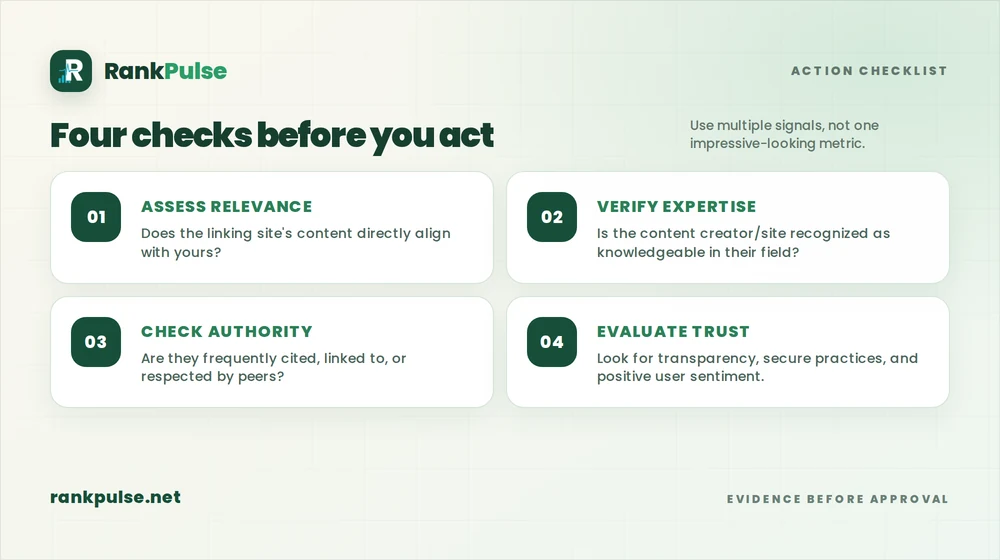
E-E-A-T breaks into four signals—and Google uses them to decide what's worth ranking.
Experience means the person writing has actually done the thing they're writing about. A tutorial on fixing a leaky faucet written by a plumber carries more weight than one written by an AI. When a site links to you, that site's authors' experience with your industry matters.
Expertise is formal or earned knowledge: certifications, years in the field, published research, recognition by peers. A cardiologist's article about heart health outranks a wellness blogger's.
Authoritativeness is what happens when expertise gets tested and confirmed. Other experts cite them. Publications request them. They get quoted in news. If the site that links to you is known in your field, the link itself gains status.
Trustworthiness is about verifiable transparency: clear author bios, correct information, published corrections when wrong, no hidden affiliate schemes. A reader should be able to trust what they find there.
The catch: when a site with strong E-E-A-T links to you, Google doesn't just see "a link." It sees a trusted voice vouching for you. That's worth far more than generic metrics can measure.
How to Spot E-E-A-T Signals in Your Existing Backlinks
Audit your current backlink profile. For each linking domain, look for real signals of expertise, authority, and trustworthiness—not just automated metrics.
| Signal | What to Check | Red Flag |
|---|---|---|
| Relevance | Does the site's content align with your industry? | Tech site linking to your dental practice with no connection |
| Expertise | Are the writers/site recognized as knowledgeable? | Generic content mill with no author information |
| Authority | Do other respected sites cite or link to them? | Site with no backlinks from industry peers |
| Trust | Clear author info, secure site, no sketchy practices? | Hidden authors, HTTP instead of HTTPS, affiliate-heavy |
| Traffic | Real, consistent organic visitors each month? | A spike last month that vanished, or obviously bot-driven numbers |
| Editorial Quality | Professional writing, fact-checked, well-formatted? | Spelling errors, AI-generated feel, thin or outdated content |
You don't need all four E-E-A-T signals perfect. But if two red flags appear, remove the link. Audit your current links against these standards. When you find unqualified ones, remove them or add nofollow tags immediately—both to stay compliant and to help mitigate potential negative impacts on your profile. (Google's spam policies require proper tags on paid links; check their documentation.)
Building Backlinks That Actually Reflect E-E-A-T
Link builders stumble here by pitching guest posts to any site with decent domain authority. That's backwards.
Start by asking: Would I trust this site? Would an actual expert in my field?
Target sites where your buyer actually spends time, sites with original research and real authors rather than regurgitated content. The author should have a genuine track record—check their byline history, look for citations in your industry, see if peers mention them.
When you pitch, focus on relevance and audience quality, not metrics. Say: "Your readers include SaaS founders evaluating billing tools. We built one. Here's a case study of how we reduced billing errors by 40% in our first three months." An editor buys that because it serves their readers.
What Vetted Inventory Looks Like in Numbers
I maintain a reviewed publisher dataset built from thousands of records. Across a 550-site sample of sites I actually use in client campaigns, many sit at DR 70 or higher. That's not by accident. Those sites pass the E-E-A-T smell test.
Data note: Our guest post prices range from $30 to $1,520, with a median of $60. The expensive ones aren't the scam. They're usually sites with real readers and real editorial standards.
Consider a leading health information portal: real traffic from doctors and patients looking for specialists. For a healthcare software company, a link from such a site means something. That's E-E-A-T in action.
FAQs on E-E-A-T and Link Building
Can paid links work if they're sponsored or nofollow-qualified?
Yes, when properly qualified. Paid links that carry rel="sponsored" or rel="nofollow" comply with Google's policies. Without these attributes, paid links are treated as link spam.
How do I spot a high E-E-A-T site before I pitch?
Visit it. Read the homepage and three recent articles carefully. Check author bios thoroughly. Google the site name plus "reviews" to see what people say.
Should I remove all my low-DR links?
Not automatically. Low domain authority doesn't equal low quality. Some of the best links come from small, highly relevant niche blogs with DR under 30. What matters is whether the traffic is real, the content is genuine, and the audience cares. Delete links because the E-E-A-T is low, not because the DA is.
How often should I check on my links?
Check quarterly for broken or moved links, but do a deeper audit once or twice a year to re-examine quality.
What if a link from a site that has deteriorated in quality appears in my profile?
Reach out immediately. Ask them to add a nofollow tag or remove your link. Google understands that sites change hands and quality can drop. The faster you request a nofollow or removal, the better. Document the exchange. This advice applies to any link in your backlink profile, regardless of its origin. If you acquired a link through RankPulse, we ensure proper qualification with rel="sponsored" or rel="nofollow" attributes from the start to prevent such situations.
Can I tell from DA/DR alone if a site is E-E-A-T compliant?
No. DA and DR tell you link authority, not whether the site's content is trustworthy or the author is an expert. I've seen DR 80 sites that are pure content farms, and DR 30 sites that are legitimate niche authorities. Metrics are a starting point. The site itself is what matters. Visit it, read it, make your own call.
For a deeper dive on how core updates affect link strategy, see our guide to core updates and quality link building. Learn more about our guest posting service and pricing.
Ready to audit your backlink profile through an E-E-A-T lens? Reach out to Zahid at zahid@rankpulse.net. I can walk you through your current profile and build a plan aligned with how Google actually ranks now.
Disclosure: RankPulse facilitates placements with publishers in our network. Paid placements are subject to Google's policies and must be properly qualified with rel="sponsored" or rel="nofollow" attributes. We handle vetting, transparency, and editorial quality so our clients can make informed decisions about where their links come from.

Level 2 Fiverr seller with a 5.0 rating. Has reviewed thousands of publisher records to build a curated placement inventory since 2024. Fiverr profile · zahid@rankpulse.net