RankPulse Blog
Google Core Updates: Why Your Backlink Profile Needs Strength
 By Zahid · Founder, RankPulse · Published 2026-07-05
RankPulse Blog
By Zahid · Founder, RankPulse · Published 2026-07-05
Your traffic dropped in the last few weeks and you still don't know why. If that sounds familiar, check your backlink profile first, because Google squeezed two major updates into five weeks this year: a core update that kicked off around May 21, 2026, and a spam update that wrapped on June 26, 2026. Search Engine Roundtable and Search Engine Journal both tracked real ranking volatility during those windows, and sites with weak link profiles felt both hits back to back.
Google runs core updates several times a year and documents every rollout on its Search Status Dashboard. No leaks or guesswork required, you can check start and end dates yourself.
The May 2026 core update started rolling out around May 21, 2026. Then on June 26, 2026, Google wrapped the June 2026 Spam Update, a separate action aimed at manipulative link schemes and low-quality content. Search Engine Roundtable and Search Engine Journal covered heavy volatility across both windows.
Two updates that close together is a lot for any site to absorb. Sites with thin content, no topical authority, or sketchy backlinks got hit twice in one stretch.
Google's spam policies page says outright that link schemes built to manipulate rankings violate its guidelines (developers.google.com/search/docs/essentials/spam-policies). Backlinks are still one of the clearest trust signals Google's systems rely on, even with all the added sophistication around content quality and user experience.
A strong profile isn't about how many links you have. It comes down to three things: quality (real sites with real traffic), diversity (different domains, different link types, varied anchor patterns), and relevance (sites that actually connect to your niche).
A weak or spammy profile becomes a real liability the moment Google tightens enforcement. I've watched accounts with heavy PBN or link-exchange histories lose 30-40% of organic traffic within days of a spam update. That's not universal, but it's a pattern that keeps showing up across update cycles.
Guest posts done right land on real sites: organic traffic, an actual editorial process, and content that fits your niche. That's the bar we hold every placement to through our guest posting service.
The criteria matter more than the label "guest post." A link is only as good as the site hosting it. Does it get indexed, does it rank for anything, would an actual human land there searching for something related to your business?
Domain Authority (DA) gets tossed around a lot in this industry, but it's worth being straight about it: DA is a Moz metric, not a Google ranking factor. We use it to shortlist candidate sites fast, but the real test is the organic traffic trend, topical relevance, and whether the site behaves like a genuine publication instead of a link farm.
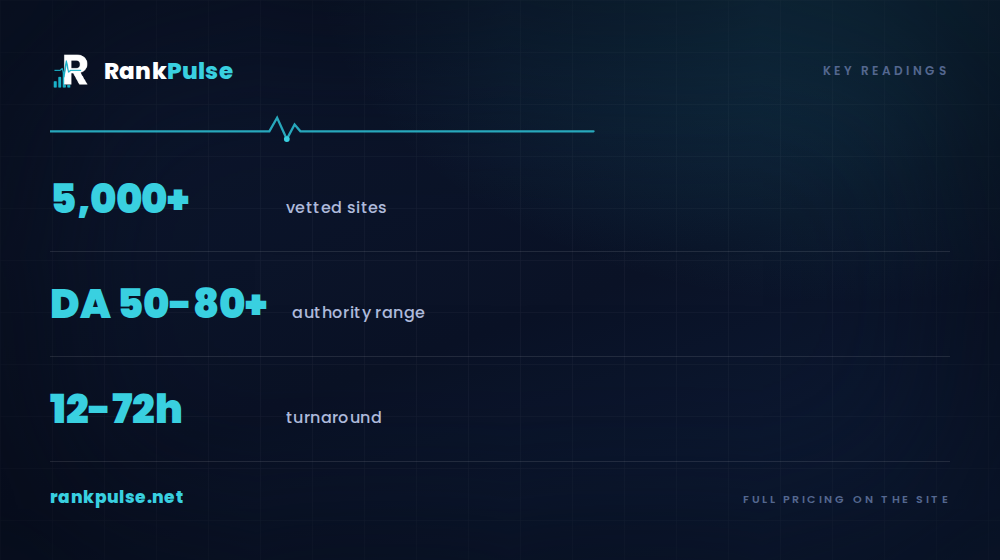
The examples below come straight from our current inventory, drawn from roughly 19,000 analyzed domains and a vetted pool of 5,000+ sites reviewed for traffic and editorial quality.
| Site | DA | DR | Monthly Traffic |
|---|---|---|---|
| thehansindia.com | 79 | 77 | 1.1M |
| thisdaylive.com | 79 | 78 | 130K |
| hackmd.io | 69 | 83 | 4.7M |
| techbullion.com | 49 | 80 | 330K |
| ilounge.com | 44 | 74 | 118K |
Full disclosure: this is a commercial offering. RankPulse sells placements and niche edits on sites like these, and I'd rather say that plainly than bury it. We vet for real traffic and editorial fit before any site enters inventory, but a paid placement is a paid placement, and we're not going to pretend otherwise under Google's guidelines.
If a site already ranks and has relevant existing content, a niche edit (slotting your link into an already-published article) is often faster and lower-risk than commissioning a brand-new guest post. Pricing for both is on our pricing page.
Reactive link building, the kind you scramble into after a traffic drop, is expensive and slow. You're rebuilding trust signals under pressure, usually while also patching up content and technical problems at the same time.
Proactive, steady link acquisition compounds instead. A handful of quality placements a month, kept up over a year, builds a profile that looks natural because the pace actually is natural.
I manage guest post and niche edit campaigns for SaaS, eCommerce, and agency clients across a range of niches. In our own tracking, accounts that kept running continuous, modest link campaigns showed noticeably smaller swings during the May and June 2026 update windows than accounts that had paused link building for months. Results vary by niche and starting point, but the pattern has held across update cycles.
Core updates generally take one to three weeks to fully roll out, and Google tracks rollout status openly on its Search Status Dashboard so site owners aren't left guessing. The May 2026 core update started around May 21, but ranking effects kept shifting for weeks afterward as the update propagated, which is normal during any core rollout.
There's no single formula that works for every site, but a healthy profile usually blends editorial guest posts, niche edits on existing content, some natural mentions, and a handful of directory or resource links. Spread that across dozens of different referring domains. Diversity in link type and domain source reduces the odds that any single pattern reads as manipulative.
Usually it shows up as a ranking drop from an algorithmic update, not a manual action. Manual penalties are rarer and reserved for clear, deliberate violations of Google's spam policies, which are worth reviewing on Google's own documentation before assuming the worst.
A steady monthly cadence beats big bursts followed by long gaps, mainly because it mirrors how natural link acquisition looks over time. The right volume depends on your site's age, how competitive your niche is, and your current link velocity, so assess those before locking in a fixed number.
Niche edits can work just as well when they land on genuinely relevant, already-ranking pages, and they're often quicker to secure since there's no new content to commission. Full guest posts still win when you need control over topic and anchor placement, which is why most solid strategies use both.
Questions about any of this, or want a second opinion on your current link profile before the next update cycle? Reach me directly at zahid@rankpulse.net.
Level 2 Fiverr seller with 181+ delivered orders and a 5.0 rating. Has vetted 5,000+ guest-post sites from a 19,000-domain database since 2024. Fiverr profile · zahid@rankpulse.net
Send your niche and budget — matching sites with DA/DR/traffic and prices within hours.
Email zahid@rankpulse.net WhatsApp Us