RankPulse Blog
Guest Posts vs. Niche Edits: Which Builds Rankings Faster?
The Real Question You're Asking
You've tried cheap link packages that promised big rankings and got nothing. Or you bought into a "niche edit" campaign and watched your traffic stay flat. Now you're comparing guest posts versus niche edits, and you want to know which one actually moves the needle faster. The honest answer isn't what most vendors tell you, and it matters.
- Guest posts and niche edits work through different mechanisms. Guest posts build authority through fresh content; niche edits leverage existing content's credibility.
- Neither delivers overnight ranking gains. Link quality, relevance, and context beat speed every time.
- Across our 550-site sample, median guest post prices sit at $60, with a median DA of 49. Thirty-seven percent of inventory has a DR of 70+.
- Your real edge is vetting: transparent metrics, actual traffic numbers, and editorial relevance matter more than which tactic you pick.
What You're Actually Buying: Guest Posts vs. Niche Edits
A guest post is original content you write (or have written) that gets published on another site with a link back to yours. You control the topic, the tone, and the anchor text. The host site gets fresh content for their audience. You get a link, visibility, and a chance to build authority in your niche.
A niche edit is different. Someone finds an existing article on a relevant site, spots a gap or outdated reference, and inserts a link to your page mid-content. No new article. No fresh writing. Just a surgical placement in an already-published, already-ranking piece.
Why Speed Isn't the Real Story
Links don't work that way. Google crawls the page, discovers the link, evaluates the source, checks relevance, and over weeks or months, may or may not pass ranking credit your way. You cannot publish a link on Monday and rank on Tuesday, nor does Google process link velocity with speed-to-results as the primary factor; the system is far more nuanced and dependent on content quality, site authority, and topical relevance signals that develop gradually.
Niche edits can feel faster because the hosting page already has traffic and authority. You're inserting your link into established content that's already indexed and ranking. That contextual relevance can matter. But faster doesn't mean it works. A poorly-vetted niche edit on a spammy site or a site that's been penalized will sit there doing nothing, or worse.
Guest posts take longer to show up in rankings. The new article has to be indexed, crawled, and proven relevant to your topic. But if the site is legitimate and your content is solid, you're building something real: a real backlink from a real article on a real publication.
The question isn't which is faster. It's which is less likely to waste your money.
Guest Posts: What You Get and What You're Paying For
A good guest post site has real traffic, real readers, and actual editorial standards. You're not just buying a backlink. You're buying an audience. When someone reads your article and clicks through to your site, that's traffic. That's real.
You also control the narrative. You can pick your topic, shape your argument, and choose your anchor text. If the host editor is worth their salt, they'll help you land on something that serves their readers and your business at the same time.
One example from our vetted inventory: a site with strong authority in tech publishing that maintains consistent traffic and editorial standards. A guest post on such a site costs more than a bedroom-blogger site would, but you're getting a link from a real publication with real authority and real readers. That's the premium, and it's earned.
In our 550-site sample, guest post prices range from $30 to $1,520, with a median of $60. That median sits right in the sweet spot where quality starts to show up. Eighty-three percent of our inventory sites are priced at $100 or less, which means accessible quality exists if you vet properly.
Niche Edits: Speed vs. Risk
A niche edit promises efficiency. You're inserting a link into existing content that's already ranking and bringing traffic. No waiting for a new article to gain traction.
The catch: editorial barriers are real, and vetting gets harder. A niche edit seller needs to find natural spots where your link makes sense. That means the site has to be relevant, the article has to be contextually appropriate, and the insertion has to look earned, not shoehorned. Many sites don't meet those standards. Many edit-seekers don't vet properly.
A site like livelivepositively.com (DA 61, DR 73, 32.4K monthly traffic), which has achieved its metrics through gradual organic growth, might accept a niche edit. But you need to verify that traffic number yourself, look at the site's actual content quality, and spot-check whether their existing links look natural or stuffed. One spike in DR with no other metric changes? Red flag. A site that went from DA 30 to DA 70 in two months? Walk away.
What Google Actually Cares About
Google's spam updates target link spam through periodic reviews. Their spam policies explicitly cover links intended to manipulate PageRank. Paid links that pass ranking credit need proper qualification with rel="sponsored" or rel="nofollow" attributes where appropriate.
The real question isn't whether guest posts or niche edits are lower-risk. It's whether the link comes from a legitimate context in a real site with real relevance to your niche. Both tactics work if executed right. Both fail if you're careless about vetting or buying from sellers who don't vet at all.
Which Builds Resilient Ranking Momentum?
Guest posts edge ahead for long-term ranking stability. You get a backlink and an audience. Even if Google's algorithm shifts and link weight changes, you've still driven real people to your site. That traffic signal is independent of the link itself. Over time, a portfolio of guest posts creates E-E-A-T (Experience, Expertise, Authoritativeness, Trustworthiness) signals.
Niche edits create ranking momentum faster if the site and placement are solid. But they're dependent on one thing: link weight. If Google tightens how much credit they pass through paid links, your niche edit does less. A guest post at least leaves you with the audience and the content footprint.
The real answer: combine both. Build a diversified backlink profile. Use guest posts for authority and audience growth. Use niche edits selectively for contextual relevance on high-authority sites where the placement feels natural.
How to Actually Choose
First, align with your goal. If you need brand awareness in your niche, guest posts win. If you need specific keyword rankings and you have a tight budget, niche edits on the right sites can deliver sooner.
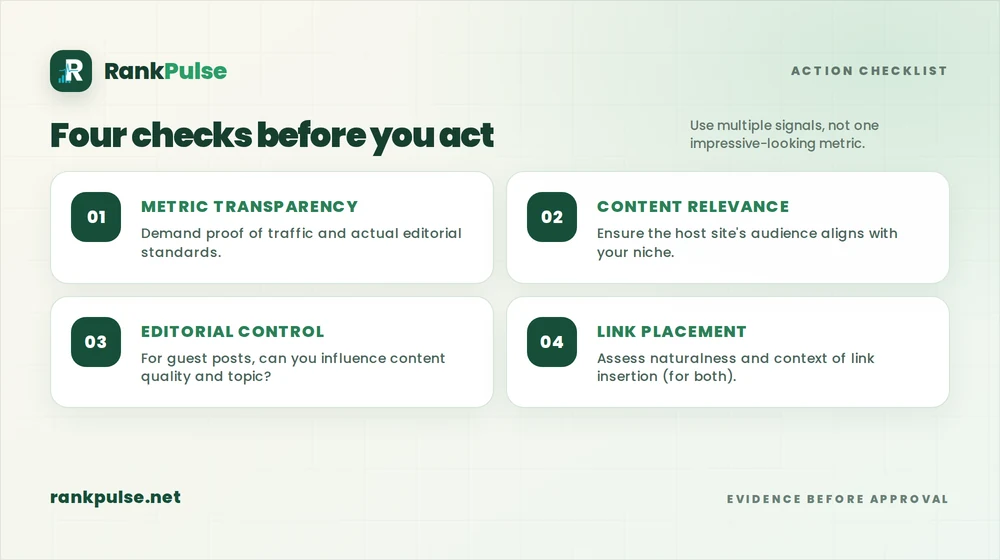
Second, vet ruthlessly. Demand proof of traffic. Ask for Google Analytics screenshots, or use a tool like SimilarWeb to spot-check claimed monthly visitors. A site claiming 50K monthly visitors but showing zero traffic on external checks is a lie.
Third, check the metrics across time. A domain authority jump from 30 to 65 in two months is suspect. Real sites grow slowly. A DR that's stayed between 70 and 75 for a year? That's earned authority worth buying.
Fourth, ask about link placement. For a guest post, can you see examples of how they edit and layout author bios? For a niche edit, where exactly will your link sit? A link buried in a footer or squeezed into a sidebar is weaker than a contextual link in the body. Any seller who won't show you examples is hiding something.
The Numbers in Context
Data note: from our tracking of approximately 550 vetted guest-posting sites.
Across our 550-site sample, we found a median DA of 49 and a median DR of 63. That's the average site you'll see. Thirty-seven percent of our inventory has a DR of 70 or higher, which puts you in genuinely authoritative territory.
For tech sites specifically, where both guest posts and niche edits are common, our 55-site tech sample shows a median price of $50 with a median DA of 46. The point: you don't have to spend $500 per link to get quality. Eighty-three percent of sites in our inventory are priced at $100 or less.
FAQ
How do I actually compare cost against quality?
Don't just look at price. A $40 link from a site with 10K real monthly visitors and a genuine audience beats a $200 link from a ghost site with zero traffic. Demand proof of traffic from multiple sources. Cross-reference claimed DA and DR on Moz and Ahrefs yourself. If the numbers don't match, ask why.
Are all niche edits risky?
No, but many are. The risk comes from site quality and editorial context. A niche edit on a spam site won't help you and might hurt. A niche edit that doesn't fit the article's topic (like inserting a fitness link into a tech review) looks unnatural and signals manipulation to Google. The right niche edit on a legitimate, relevant site in appropriate context is fine. Most niche edits from cheap vendors aren't the right ones.
Can I actually measure which links moved the needle?
Attribution is messy. Use Google Search Console to track keyword rankings week over week after each link goes live. Look for keywords that climb consistently. Set up GA4 goals to track traffic from referrals. But understand: ranking movements have multiple causes, and a single link rarely moves a needle alone. You'll see clearer patterns after 20-30 high-quality links, not after one.
What's the median DA of guest post sites in your inventory?
Across our 550-site sample, the median DA is 49, representing mid-range authority that's neither top-tier nor bottom-barrel, with half the sites performing stronger and half weaker in domain strength metrics. Thirty-seven percent have a DR of 70+, which gives you high-authority options if you're willing to pay more. Quality options exist in the affordable range if you vet instead of just buying the cheapest option.
Which tactic should I start with if I'm new to link building?
Start with guest posts on relevant, mid-to-high authority sites (DA 40+). You'll learn how editorial works, how to write for external audiences, and build a track record of published work. After you have 5-10 solid guest posts, add niche edits strategically on high-authority sites where placement feels natural. This builds a resilient profile instead of betting everything on one tactic.
RankPulse's role: We sell placements across our vetted inventory of guest posting and niche edit opportunities. A paid placement intended to pass ranking credit, under Google's policies, must be qualified with rel="sponsored" or rel="nofollow" attributes, where appropriate. Our edge is vetting for relevance, traffic verification, editorial quality, and transparent metrics. We're lower-risk because we check the fundamentals before we offer you a site.
Check out our guide to vetting guest post sites before you buy for a detailed checklist, or explore our guest posting service and niche edits to see how we handle the vetting on your behalf.

Level 2 Fiverr seller with a 5.0 rating. Has reviewed thousands of publisher records to build a curated placement inventory since 2024. Fiverr profile · zahid@rankpulse.net