- Learn how to check website traffic by country to screen prospective guest post sites.
- Filter out deceptive visitor figures from automated click bots and unrelated foreign regions.
- Apply our geographic discount formula to calculate the genuine commercial value of any backlink placement.
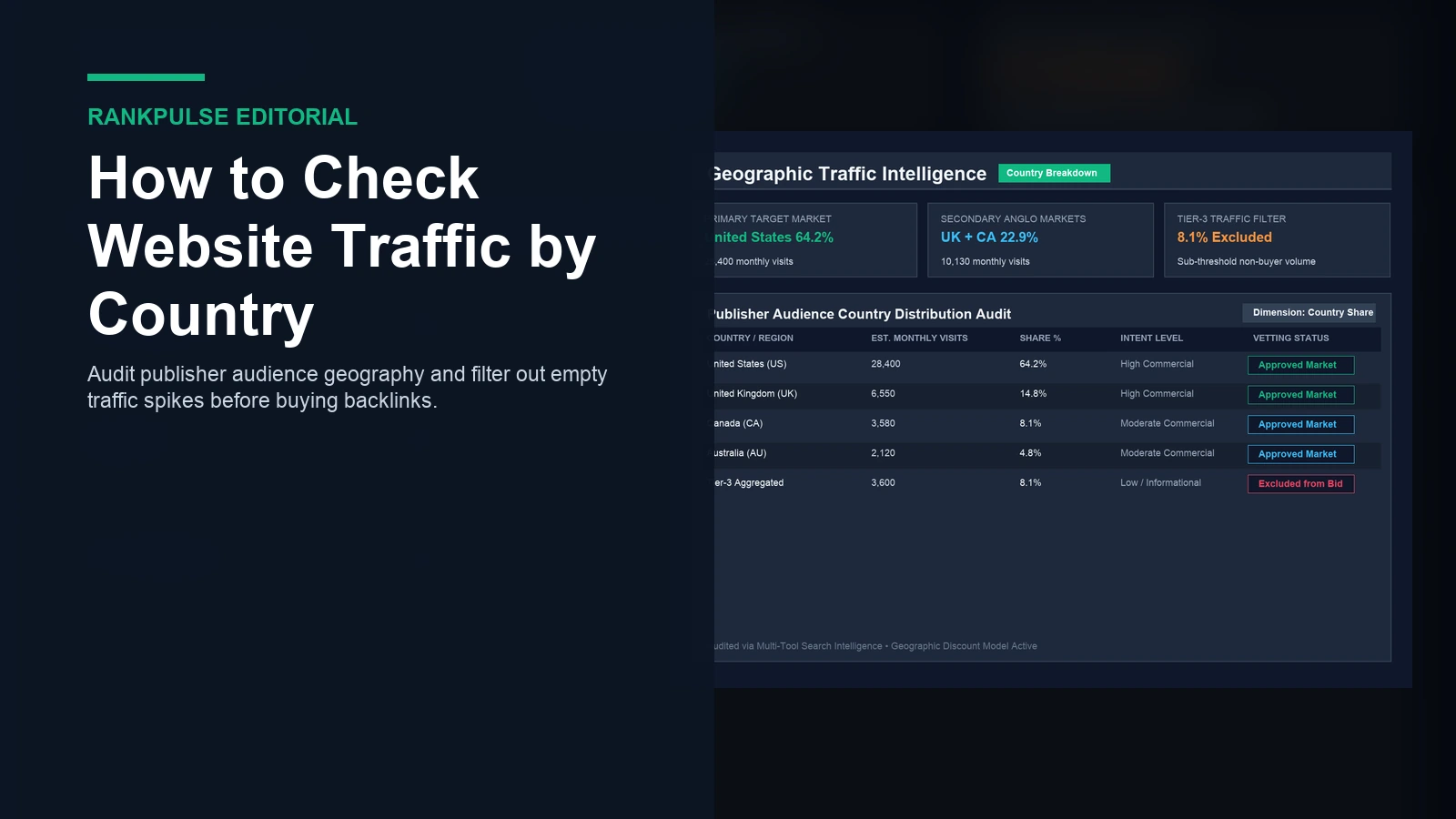
How to check website traffic by country before you order a placement? Check local keyword ranks and national search volumes. Sellers often share high visitor counts without showing where those readers live.
When a site gets most visits from foreign regions, a backlink will not help your local search ranks. You must audit location first. It saves real money.
Auditing geographic breakdown protects your budget. As shown in our practical guide on how to check website traffic without Google Analytics, public tools provide clear models. Reviewing country shares protects your cash from empty vanity metrics. It also helps you set fair prices for every guest post.
Why publisher country traffic share dictates link value
Search engines care about local context. Google systems reward content that meets search needs in specific regions. When a brand sells to clients in the United States, links from blogs with overseas readers pass weak ranking signals.
You need links from sites your real customers visit. Keep that rule front and center.
Gross visitor counts easily mislead buyers. A publisher showing fifty thousand monthly visits looks strong at first glance. But if forty-five thousand of those visits come from non-buyer regions, the link adds little value.
Our guide on how to vet guest post sites explains why relevance beats raw volume every time. Do not buy blindly.
Click farms operate overseas. Shady sellers buy fake hits to inflate public metric charts. Checking audience location exposes these tricks before you sign an order.
How to check website traffic by country in four steps
Auditing the geographic footprint of any third-party blog follows four simple steps.
Step 1: Inspect national keyword ranking distribution
Start with ranking terms. Look at how many search queries the domain ranks for across distinct regional search markets. Major SEO tools track country search databases one by one.
Open the regional tab. A healthy blog should show strong keyword depth across its main target countries.
Step 2: Compare top search queries against regional intent
Inspect top queries closely. Review the specific search terms that drive visitor volume to the prospective publisher. Check whether ranking pages solve commercial problems or broad definitions.
If a domain claims a United States audience but ranks mainly for viral video terms abroad, the site is a poor fit. Our guide on finding unique monthly visitors shows how search intent shapes real reader engagement. Intent reveals truth.
Step 3: Correlate search data across multiple estimators
Never trust one estimator. Different tools use different click models and update cycles. Compare country shares across two tools to build a verified baseline.
Official advice in the Google Search Console performance guide notes how location affects search results. If tools disagree widely, pause and dig deeper.
Step 4: Audit referral paths and outbound backlink patterns
Look at inbound links. Quality sites attract links from real companies in their home market. If an English-language site only gets links from foreign web rings, be wary. Our guide on guest post traffic proof outlines checks to spot inflated visitor claims.
Check quality standards too. High quality sites follow Google Search Central helpful content guidelines by serving clear human audiences. Real readers matter.
Auditing traffic distribution and spotting bot spikes
Knowing what makes a safe geographic spread helps you make smart link purchases. The audit matrix below shows clear benchmarks for link acquisition campaigns.
| Traffic Tier | Target Region Share | Search Keyword Diversity | Editorial Quality Signal | Buyer Action |
|---|---|---|---|---|
| Tier A: Prime | 60% or higher in target country | Over 500 top-20 ranking keywords | Natural local editorial focus | Approve at standard placement rates |
| Tier B: Acceptable | 40% to 59% in target country | 150 to 500 ranking keywords | Broad international audience | Approve with modest rate negotiation |
| Tier C: Borderline | 20% to 39% in target country | 50 to 149 ranking keywords | Generic lifestyle or aggregation | Require steep price discount |
| Tier D: High Risk | Below 20% in target country | Under 50 ranking keywords | Sudden spikes without ranking depth | Reject placement immediately |
Watch out for spikes. Look out for sudden visitor spikes without new keyword ranks. Fake networks route automated hits through cheap proxy servers.
Official rules in Google Search Essentials spam policies warn against artificial traffic that tries to game search evaluation. Stay alert during every review. Quality always wins.
Geographic traffic valuation and discount formula
Use our simple valuation equation. To avoid overpaying for links with weak regional reach, use our geographic discount formula. This equation calculates effective commercial visits instead of raw numbers.
Effective Commercial Traffic = Total Estimated Visits × Target Country Share % × (1 - Bot Risk Factor)
Here is an example comparing two publisher options:
- Publisher Alpha: Reports 60,000 monthly visits. The geographic breakdown shows only 15% in the United States, with 85% scattered across low-intent regions. Applying the formula yields: 60,000 × 0.15 × 0.90 = 8,100 effective visits.
- Publisher Beta: Reports 18,000 monthly visits. The geographic breakdown shows 72% in the United States, supported by strong national rankings. Applying the formula yields: 18,000 × 0.72 × 0.95 = 12,312 effective visits.
Real reach matters most. Publisher Alpha claims three times more total volume, but Publisher Beta delivers fifty percent more real buyer reach. Paying more for Publisher Alpha wastes your link budget.
View our placement inventory and pricing to browse vetted publishers audited for real regional audiences. Pick proven sources.
Frequently asked questions
Why is country traffic share more critical than total visitor count?
Gross visitor numbers often hide bot farms or irrelevant users. A site with 10,000 monthly visits from your primary market brings more revenue and search authority than a site with 100,000 visits from untargeted countries.
Can you check website traffic by country without access to Google Analytics?
Yes, public search tools track local keyword ranks and click trends. These tools estimate country shares with enough accuracy to vet prospective publishers.
What percentage of target-country traffic should an approved publisher have?
For United States or United Kingdom campaigns, seek publishers with at least 50% of their organic visits in your target region. Portfolios under 30% require large price discounts.
How do you spot artificial traffic spikes from click farms?
Check the ratio between ranking keywords and visitor counts across countries. If a domain ranks for few terms in a region yet shows big visit spikes, bot networks are usually at work.