RankPulse Blog
Spotting Fake Backlinks: How to Verify Metrics & Avoid Bad
You paid for ten guest posts last quarter. The seller sent screenshots of Domain Authority in the 60s, Domain Rating over 70, "50,000 monthly visitors." Three months later, rankings haven't moved and one of those ten sites doesn't even resolve anymore.
Key Takeaways
- A high DA or DR score alone doesn't confirm anything: across our 550-site sample, the median DA is 49 and median DR is 63, and inflation happens above and below those numbers.
- 37% of our vetted inventory carries DR 70+, but price and traffic vary enormously even within that group.
- Traffic that spikes once and disappears is a stronger red flag than a "low" number that stays flat and consistent.
- Paid links that pass ranking credit without a rel="sponsored" or rel="nofollow" tag fall under Google's link spam policies.
Source note: For Google policy or update references, this article uses Google documentation and treats unsupported update-target claims as audit guidance, not confirmed targeting.
If that sounds familiar, you're not alone. Most link buyers I talk to have paid for at least one package that promised big numbers and delivered nothing measurable.
The DA/DR figures looked real. The traffic didn't exist, or it vanished after a week.
The figures below come from a 550-site sample pulled from our reviewed publisher dataset. Here's what actually separates a real link from an inflated one.
The Metrics Sellers Love to Show You
Domain Authority is a metric from Moz. Domain Rating is a metric from Ahrefs. Sellers know buyers treat them like a trust badge, so a lot of effort goes into pushing these numbers up artificially.
They use fake link networks, PBNs, and internal link manipulation to boost scores. None of this tells you whether a real reader will ever see your link.
Across our 550-site sample, median DA sits at 49 and median DR at 63. Of that inventory, 37% has DR 70+. Those numbers only matter once you check what's underneath them.
How to Spot Fake Traffic and Thin Sites
Traffic claims are the easiest thing to fake and the hardest thing for buyers to verify. A screenshot from an analytics dashboard proves nothing. Ask for a live SimilarWeb or Ahrefs traffic overview instead, and look at the shape of the graph, not just the current number.
Watch for sudden, unexplainable spikes versus consistent organic growth over time. Once you know what to look for, it takes a few minutes:
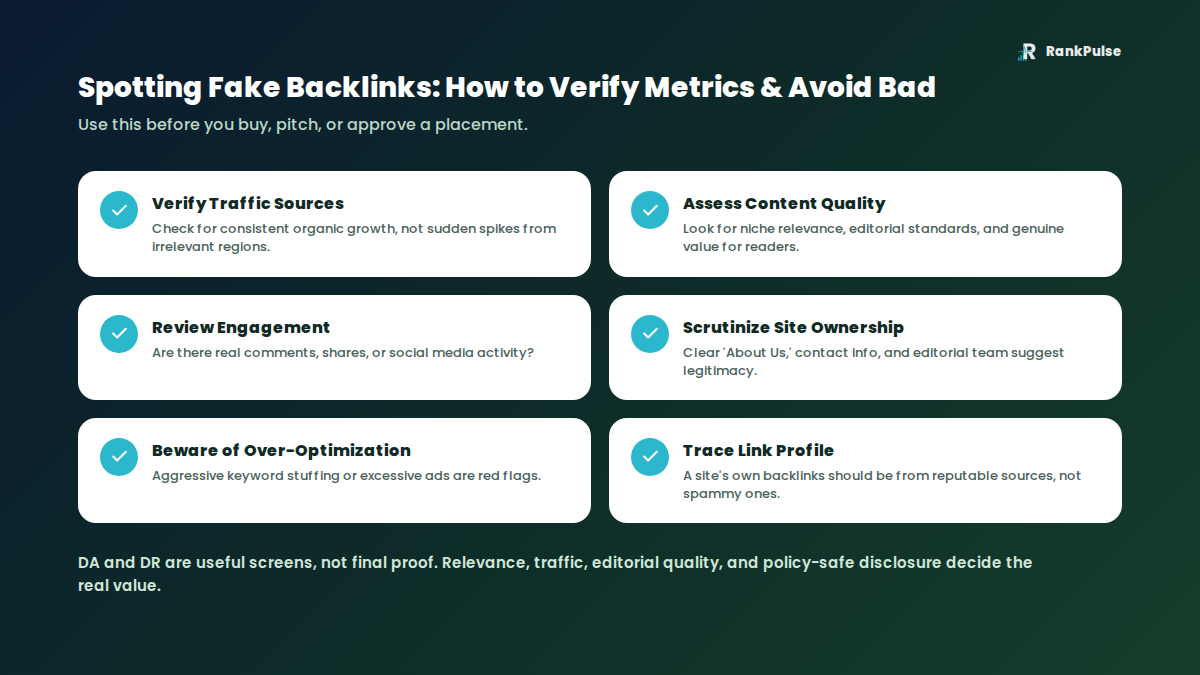
- Verify traffic sources. Look for consistent organic growth, not a sudden burst from a country with no obvious connection to the niche.
- Assess content quality. Read three or four articles. Spun or generic filler content is a sign the site exists to sell links, not to inform readers.
- Review engagement. Are there real comments, shares, or social media activity? A site with no genuine interaction likely has no real audience.
- Scrutinize site ownership. A clear "About Us" page, contact info, and named editorial team suggest legitimacy.
- Beware of over-optimization. Aggressive keyword stuffing or excessive ads are red flags.
- Trace the link profile. A site's own backlinks should come from reputable sources, not spammy ones.
FAQ
How frequently do website metrics need to be checked?
Check DA, DR, and traffic before every new placement, not just once at the start of a relationship. Metrics can shift within weeks if a seller adds or drops link networks. A number you approved last quarter may not hold today.
Can a site with low DA/DR still be valuable for a backlink?
Yes. A site like PawsitiveLiving.com carries DA 40 and DR 73 but only 5K monthly visitors. A niche-relevant site with lower authority but genuine, engaged readers can pass more real value than a high-DR site with no traffic. Relevance and real readers matter more than the score alone.
What's the difference between a "sponsored" link and a "paid" link in Google's eyes?
Google's spam policies state that links intended to manipulate ranking may be considered link spam unless properly qualified with rel="sponsored" or rel="nofollow" where appropriate. A paid link without that attribute is treated as an attempt to pass ranking credit. A properly tagged sponsored link is not.
How can I recover if I've already invested in low-quality backlinks?
Start by auditing your existing links against the checklist above. Request removal or a rel="nofollow" tag on anything that fails. Our guide on vetting guest post sites before you buy walks through a fuller audit process for links already in place.

Level 2 Fiverr seller with a 5.0 rating. Has reviewed thousands of publisher records to build a curated placement inventory since 2024. Fiverr profile · zahid@rankpulse.net