RankPulse Blog
What a 6-Month Link Replacement Guarantee Should Cover
A six-month link replacement guarantee should define a lost link, set a response deadline, protect replacement quality, and explain when a refund or credit applies. If any of those terms are missing, you won't know how to claim the guarantee when a link dies.
- Define loss in writing, including removal, de-indexing, and long outages.
- Set separate deadlines for acknowledgement and replacement.
- Require a relevant replacement with comparable traffic and editorial quality.
- Add a refund or credit rule for cases the seller cannot resolve.
Source note: For Google policy or update references, this article uses Google documentation and treats unsupported update-target claims as audit guidance, not confirmed targeting.
Why the wording matters
"Six-month replacement" sounds clear until you need to use it. One seller replaces only a deleted page, while another covers a de-indexed domain or a publisher that removes the link entirely.
Vague language costs you when a link fails. Before you pay, insist on a written checklist both sides agree to. Otherwise sellers interpret the promise however they want.
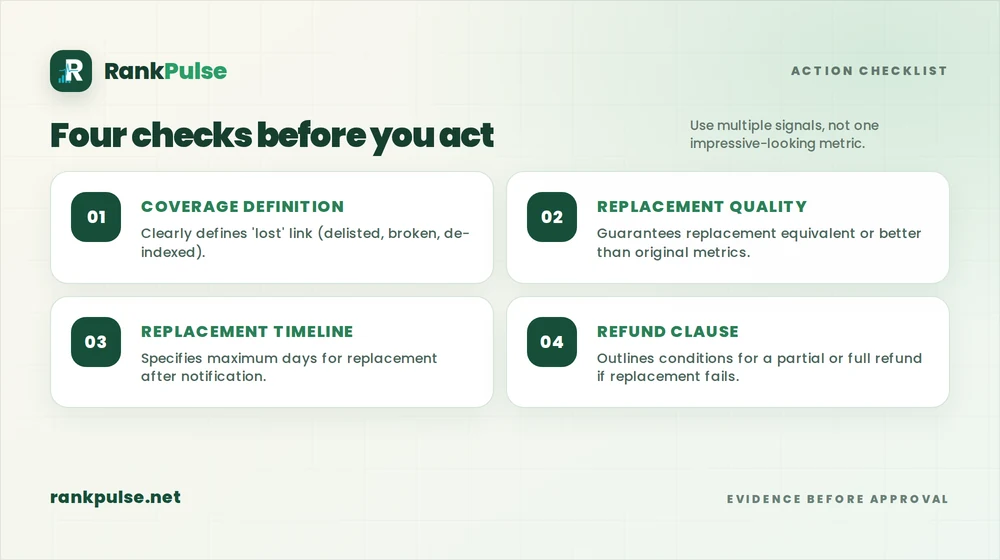
Four clauses every replacement guarantee needs
1. A clear definition of link loss
Start with the triggering event. A link gets deleted—that's straightforward. Pages and domains that get de-indexed, plus extended outages, need careful wording. The seller and you may see them very differently.
- Link removed: the article stays live, but the agreed link is missing or changed.
- Page removed: the article returns a 404, redirects elsewhere, or is no longer public.
- Page de-indexed: the page stays online but drops from Google Search for a set period.
- Domain de-indexed: the publisher's site stops appearing in Google Search results.
- Extended outage: the website stays unavailable beyond the written threshold.
Short downtime happens all the time. Set a threshold, like a review after 14 days, instead of treating every temporary error as permanent loss. The exact number varies. What matters is agreeing upfront.
2. Two deadlines, not one
A replacement window alone isn't enough. The seller must confirm the problem first, then fix it by a deadline.
For example: acknowledgement within five business days, suitable replacement within 45 days. Pick a schedule that fits your campaign, then state when the clock starts and what proof you need to provide.
3. Quality parity for the new placement
Fast replacement means nothing if the new site is off-topic, dead, or built only to sell links. Define quality beyond DA or DR alone. Check topical fit, recent publishing, and editorial standards. Also look at traffic trend, country fit, and link policy.
Metrics shift between approval and replacement, so use a reasonable range instead of demanding identical numbers. The new placement should solve the same business problem without quietly moving you to a weaker site.
4. A refund or credit path
Sometimes a suitable replacement doesn't exist. The agreement must say what happens next. A refund, account credit, or another option you accept should be spelled out plainly. Also clarify which fees are refundable: writing, editing, or publisher charges.
Keep this simple. If terms use vague phrases like "at our discretion" with no clear standard, ask for specifics before you order.
How to compare sellers before you buy
Don't compare guarantees by length alone. Use this checklist to score each offer: vetting process, price, and documentation.
- What events count as a lost placement?
- How quickly will the seller acknowledge a valid claim?
- What makes a replacement equal or better?
- What happens if no suitable site is available?
- What proof must each side keep?
Now ask about the vetting process. How do they check traffic patterns, domain history, recent articles, niche fit, and publisher rules? A good provider explains this without revealing client secrets. Learn more about the RankPulse guest-posting process. For another review step, see how to spot fake backlinks and inflated metrics before approving a placement.
Price needs context too. In RankPulse's 550-site sample, the median guest-post price was $60. Of those, 37% had DR 70 or higher, and 83% cost $100 or less. These show what's out there, not guaranteed results. Compare relevance and evidence instead of chasing high metrics or bargains.
Use a simple six-month monitoring plan
A guarantee only works if someone catches the problem. Save four things in one place: the approved and target URLs, anchor text, publication date, and original site metrics.
- At publication: confirm the page loads, the agreed link is present, and the article is indexable.
- During months one to three: check monthly for removal, redirects, big traffic changes, or a broken target.
- During months four to six: keep the same check and review any claim before the guarantee ends.
- After six months: monitor quarterly even if free replacement support has stopped.
If a link vanishes, take a screenshot and save the HTTP result. Email the seller in writing, quote the relevant clause, and give them the agreed window. Clear records settle disputes fast.
What the guarantee cannot promise
Paid placements have rules. Google treats paid links that pass ranking credit as link spam. Use rel="sponsored" on paid links (rel="nofollow" also works) per Google's guidance on qualifying outbound links.
That requirement changes what a responsible seller can promise. The goal is a transparent placement on a relevant site with clear terms. It's not a guarantee that one link ranks a keyword.
FAQ
Does a de-indexed page count as a lost link?
A de-indexed page triggers a replacement claim only if the agreement says so explicitly. Some sellers define link loss narrowly. Others include temporary or permanent de-indexing. Both work if documented in writing before you pay.
Should replacement metrics match exactly?
Metrics change constantly, so don't demand an exact match. Require the same niche, editorial standard, and target market within a comparable traffic range. Record the original figures so both sides can fairly judge the replacement.
What if the seller cannot find a suitable replacement?
Don't let the seller decide alone. Your written agreement must state what happens next: a refund, account credit, or another site you both approve.
Can a six-month guarantee protect rankings?
A placement guarantee covers the agreed link only. It doesn't cover rankings, traffic growth, or protection from future Google algorithm updates.
How often should paid placements be checked?
Monthly checks during the guarantee period give you time to file a claim. Quarterly monitoring works after that. Larger portfolios need automated checks plus human review before you contact the publisher.
The decision rule
Verify the guarantee in writing. You need four things: clear loss definitions, firm response times, quality parity, and a fair refund path. If the seller won't put them in writing, don't rely on the promise.
Source note: Policy references above link to Google Search Central documentation. RankPulse inventory figures come from its internal 550-site pricing sample and may change as publishers update prices or availability.

Level 2 Fiverr seller with a 5.0 rating. Has reviewed thousands of publisher records to build a curated placement inventory since 2024. Fiverr profile · zahid@rankpulse.net