RankPulse Blog
Publisher Outbound-Link Audit: Check a Site Before You Buy
- Sample recent pages in the section where your guest post would appear, not only the publisher’s homepage.
- Record each outbound link’s context, destination, commercial label and
relvalue. - Judge the pattern. One odd link needs a question; repeated unrelated paid links need a firm decision.
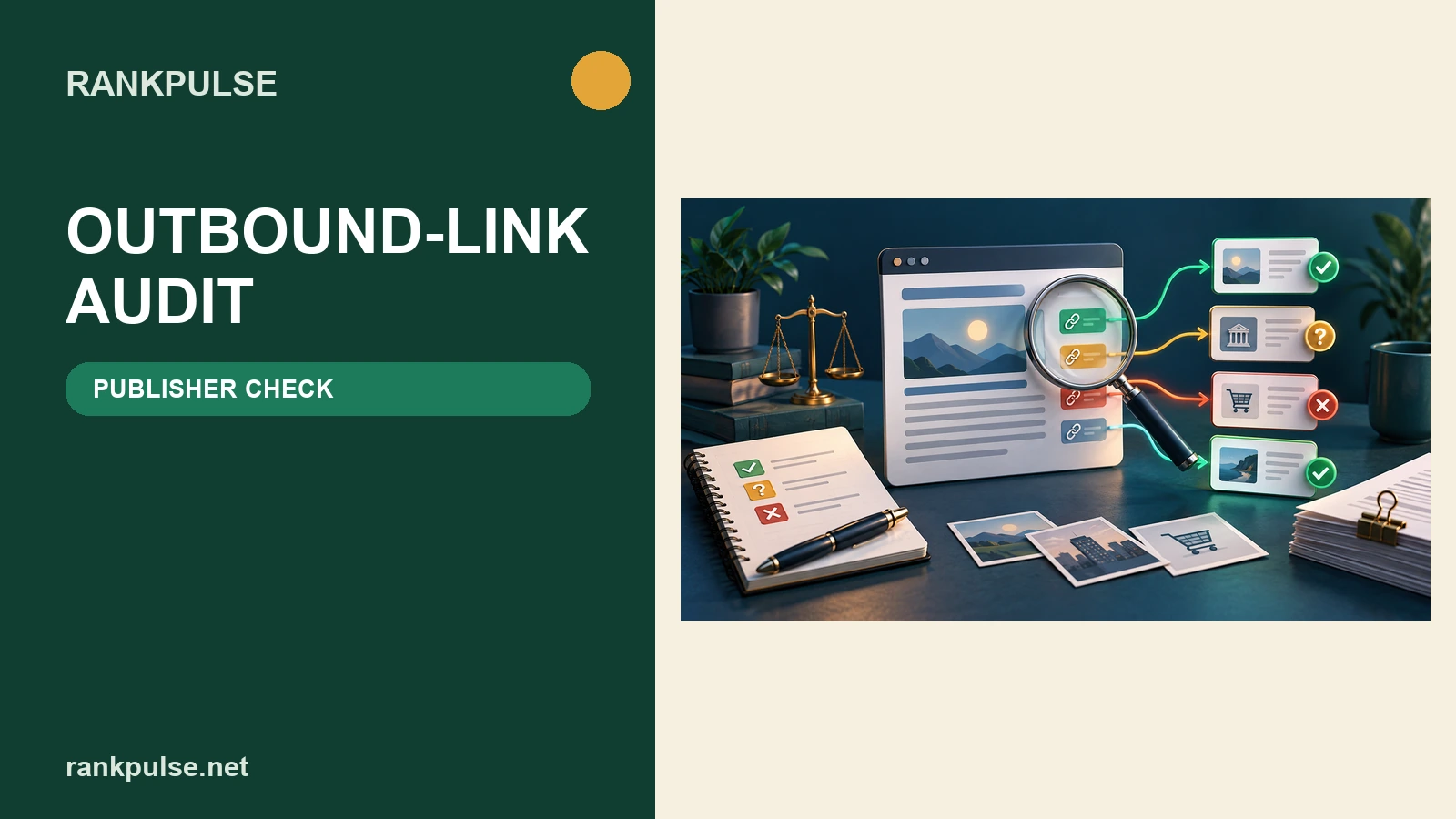
A publisher may have a polished homepage, a familiar logo and attractive third-party metrics. None of those details shows how its recent articles link to other sites.
Open the pages. A short outbound-link audit can reveal whether links support the story, point to useful sources or appear as unrelated commercial insertions. The goal is a saved buying record, not a ranking forecast.
Start with the section you would buy
Choose recent articles from the category that would hold your placement. A technology buyer should inspect the technology archive, while a finance buyer should inspect the finance pages. A clean travel section proves little about crypto.
RankPulse suggests a starting sample of six recent pages across at least two relevant sections. This is an operational review size, not a Google rule or an industry benchmark. Expand it when the evidence conflicts.
Record the page URL, publication date, section and author. The guest-post author bio checklist can help when the same account appears across unrelated subjects.
List each external link before judging it
Read the article once without tools. Mark external links in the body, author box and any sponsored module. Ignore ordinary navigation and social icons unless they are part of the offer.
Then open the page source or browser inspector. For each link, save five fields:
- Anchor: the words a reader can click.
- Nearby claim: what the sentence says the destination will support or provide.
- Destination: the page that opens, including redirects.
- Relationship: editorial source, partner, affiliate, advertiser or unclear.
- Qualification: any
sponsored,nofolloworugcvalue on the link.
Do not score a publisher from the anchor alone. A brand name may lead to a strong source or an unrelated offer. The sentence and destination must be read together.
Check whether the link helps the same reader
Write the page’s main question in one sentence. Now ask what the link adds: evidence, a definition, a tool, an example or a sensible next step.
A useful link earns its place in the paragraph. It does not need a keyword-heavy anchor. Google’s people-first guidance asks whether content serves an intended audience. It also asks whether readers learn enough to meet their goal.
If those three parts do not connect, stop. Use the topic-fit checklist. Shared vocabulary is not enough if the click changes the reader’s task.
Separate editorial links from paid relationships
Do not assume that every commercial link is hidden or improper. Advertising, affiliate partnerships and sponsorships can be legitimate. The relationship should still be understandable, and the technical treatment should match the publisher’s stated policy.
Google says links in advertisements or paid placements should use rel="sponsored". It still accepts nofollow for those links. Google’s spam policy also lists paid guest-post links that pass ranking credit, including optimized anchors, as link-spam examples.
Ask the seller how your placement will be labelled and qualified. If the offer depends on an unqualified link passing ranking credit, use the paid-link decision guide and reject that promise.
Look for a pattern, not a dramatic screenshot
One odd link can come from an old template, a missed update or a genuine editorial exception. Note it, then keep sampling.
A repeated pattern matters more. Watch for unrelated destinations across several categories or commercial anchors forced into weak sentences. Also note repeated buyer-page links and disclosures that conflict with the page source.
Traffic screenshots cannot resolve this question. If traffic evidence is also part of the sale, review it separately with the guest-post traffic proof guide. Do not turn DA, DR or estimated traffic into a claim about what Google uses.
Ask the publisher to explain the unclear rows
Send the exact URLs. Ask whether the links were editorial, sponsored, affiliate or user supplied. Request the expected label and rel value for your own page before drafting begins.
A clear answer may resolve the row. Save that answer with the order. A vague claim such as “all links are safe” is not evidence, and no provider can guarantee indexing or rankings.
For broader ownership, oversight and third-party-section questions, use the site-reputation-abuse due-diligence guide. This audit stays focused on outbound-link behavior.
Make an approve, clarify or reject record
| Decision | Pattern in the sample | Next action |
|---|---|---|
| Approve | Links support the page, relationships are clear and paid treatment matches written terms | Save the sample and agreed delivery fields |
| Clarify | A few links have unclear context, labels or source attributes | Ask about exact URLs and expand the sample |
| Reject | Repeated unrelated paid links or the sale depends on passing ranking credit | Remove the promise or choose another publisher |
Keep the record with the proposed section, article angle, destination and date checked. Publisher pages can change. Your audit describes what was visible at the time; it does not certify future behavior.
Frequently asked questions
How many publisher pages should I sample?
There is no Google-required sample size. RankPulse suggests starting with six recent pages across at least two relevant sections. Expand the sample when the pattern is mixed or the order is costly.
Is every commercial outbound link a problem?
No. Advertising and sponsorship are normal web activities. Google says paid links should be qualified with sponsored or nofollow so the commercial relationship is clear to its systems.
Does a clean outbound-link audit guarantee rankings?
No. This audit records a publisher’s current editorial pattern. It cannot guarantee indexing, referral traffic, ranking credit or future publisher behavior.
Should I reject a site after finding one weak link?
Not automatically. Check the page date, context, disclosure and wider sample. Ask the publisher to explain a clear exception; reject when the offer depends on a repeated or unresolved pattern.
Sources
Google Search Central: spam policies for link spam · Google Search Central: qualify outbound links · Google Search Central: helpful, reliable, people-first content. Source wording was checked on 2026-09-10.
Disclosure: RankPulse sells guest-post and publisher placements. This commercial interest is stated so you can judge the checklist in context. Request a shortlist with outbound-link notes.

Level 2 Fiverr seller with a 5.0 rating. Has reviewed thousands of publisher records to build a curated placement inventory since 2024. Fiverr profile · zahid@rankpulse.net