RankPulse Blog
How Many Backlinks Per Month Is Resilient in 2026?
Stop Chasing a Magic Number
Your traffic dropped. A competitor just landed three backlinks last week. Now you're wondering: how many backlinks per month can I safely build without raising a red flag? The honest answer? There's no single safe number. Anyone selling you a fixed target is oversimplifying how Google actually evaluates links.
- Quality and relevance matter far more than a monthly quota.
- Most sites benefit from 3-5 vetted links monthly, but your competitor's pace may differ based on domain age, niche, and existing link profile.
- Google's spam policies target intent and patterns, not raw volume. A handful of editorial placements beats dozens of low-effort guest posts.
- Transparency in metrics and placement context is your best defense against wasting money on links that don't stick.
Why a Fixed Backlink Count Is Misleading
I watched someone buy a link package for $500, expecting 50 backlinks a month. Every single link came from a low-traffic, off-topic domain. Six months later, that site got flagged as spammy. The volume wasn't the problem. The irrelevance and artificial speed were.
Google's spam policies are explicit: any link intended to manipulate your ranking in search results may be considered spam. That applies whether you're getting 2 links or 20. The algorithm doesn't flip a switch at month 5. Instead, it looks at your entire backlink profile for signs of manipulation: unnatural clustering, repetitive anchor text, limited source variety, and weak contextual fit.
A site with 100 domains linking to it over 12 months is far less risky than one getting 30 links from 3 related guest posting networks in a single month. Speed matters, but speed alone isn't the real signal. Intent is.
Understanding "Safe" in 2026
Safe doesn't mean invisible. It means resilient.
A resilient backlink profile has three core traits. First, source diversity: your links come from different industries, different types of sites (blogs, news, industry publications), and different regions. Second, natural acquisition patterns: link growth doesn't spike erratically or copy what a competitor just did. Third, editorial context: the link sits inside a real article written for actual readers, not stuffed into a sidebar or footer.
Reports suggest that Google's November 2023 spam update focused on reducing low-quality content and spammy link building practices. Sites that combined artificial speed with editorial irrelevance have faced greater scrutiny since that update.
Traffic and engagement on the linking site matter more than most people realize. A link from a domain with 27,000 organic monthly visits carries more implicit trust than one from a domain with 800 visits. You're not just getting a backlink. You're getting users who might actually click through. That's a real signal.
Building a Resilient Backlink Profile: What to Prioritize
Across a 550-site sample from our curated inventory, the median domain rating sits at 63 (Ahrefs), with 37% of sites rating DR 70 or higher. Those aren't just vanity metrics. A link from a DR 70+ domain gets crawled more often and carries more inherited authority. But a DR 45 site with 50,000 monthly visitors and a relevant niche can outperform a DR 80 site with 2,000 visitors and zero thematic connection.
Here's what I'd prioritize:
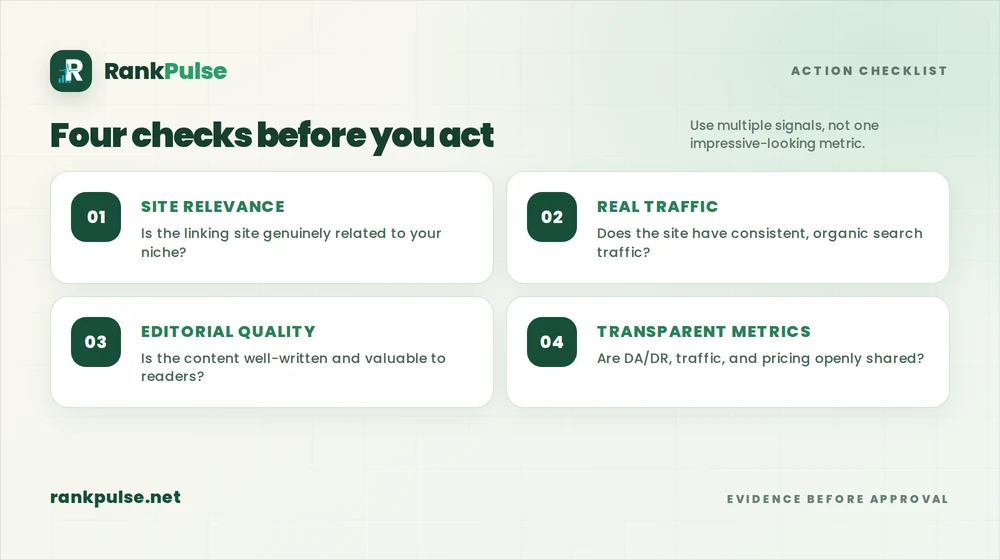
- Relevance first. Does the linking site serve your target audience? A SaaS company getting a link from a restaurant review blog gains nothing. A home security startup linked from a smart-home publication gains real value.
- Real traffic as proof. If a seller can't show you Similarweb data, Search Console traffic, or Ahrefs traffic figures, walk away. Fake metrics are cheap and easy to fake.
- Editorial placement over footer links. A link in body text, near other contextual words, signals real editorial judgment. A link in the author bio or sidebar screams paid placement.
- Transparent site selection. You should know exactly which domains your links will appear on before you pay. Not a surprise list delivered after the fact.
A site like fameimpact.com (DA 54, DR 80, traffic 27.2K/mo) or publishedvoice.com (DA 52, DR 79, traffic 118K/mo) shows what editorial assets look like in real numbers. Established sites with real audiences. That's what you're paying for.
What a Vetted Inventory Actually Looks Like
I work with a curated publisher network reviewed for traffic, authority, and editorial standards. That doesn't mean every site is perfect. It means I've audited traffic, checked for algorithmic penalties, verified that links actually appear on the live page, and confirmed that editorial standards stay consistent.
In our 550-site sample, guest post pricing ranges from $30 to $1,520, with a median of $60. Eighty-three percent of sites price at $100 or less. That range reflects real quality differences. A $30 link might come from a 30-authority micro-site with 500 monthly visitors. A $500 link comes from a 70+ DR publication with six figures in monthly traffic.
Data note: from our inventory tracking of 550 vetted domains.
Cheap links exact a hidden cost. They often come with: no direct editorial review, no guarantee the link stays live past 90 days, or the domain shared with 50 other clients that month. Moderately priced vetted placements cost more upfront. They stay in place, come with transparent metrics, and won't disappear three months later.
A transparent link partner will show you DA/DR, traffic data, the actual article where your link appears, and the anchor text before you commit. You're not guessing. You're buying based on data.
How to Think About Your Monthly Pace
Most mature sites in competitive niches benefit from 3-5 quality backlinks per month. That's not a rule. It's what I've seen work consistently without triggering rank drops or manual actions.
A brand-new domain might sustain 1-2 per month safely. An established domain with 100+ existing backlinks can probably handle 8-10 per month if they're all from topically relevant, high-traffic sources with real placement variety. A competitor building 15 per month? That's worth auditing, but it doesn't mean they're sustainable or heading for trouble.
Anchor text distribution is the real metric. If 40% of your new links use your exact-match keyword as anchor text, that's risky. If they're spread across branded, partial-match, and naked URL anchors, you're safer. Speed combined with repetitive anchor patterns is what draws scrutiny.
Start with an audit of your current link profile. Use Ahrefs, Semrush, or Moz to see how many backlinks you've gained in the past six months, where they came from, and what keywords they use. Then set a pace that's roughly 20-30% higher than your historical average. Move gradually. The algorithm rewards consistency, not sudden jumps.
Avoiding the Cheap-Link Trap
I see this every month. Someone buys 100 links at $5 each from a service claiming a proprietary database. The links go live. Two weeks pass, excitement builds. By month three, half are gone. By month six, the domain gets a manual action.
Low-cost providers cut corners in ways you won't spot upfront. They might place your link on 50 sites but use the exact same anchor text on 40 of them. They might use aged domains with hidden penalties. They might not even verify the link appears on the live page after purchase.
Red flags to watch for:
- No transparent metrics. If they won't show DA/DR or traffic data before you buy, that's intentional.
- Bulk pricing that is unrealistically cheap. If pricing is far below market value, the supply chain is compromised.
- No editorial review process. Real placements involve a conversation about content fit and anchor text strategy.
- Ranking guarantees. Anyone promising you a ranking boost in exchange for links is selling fantasies.
- Vague site lists. You should see exactly which domains you're getting before you pay, not a generic "tier 1" promise.
Working with a vetted inventory has more friction. The results are predictable.
The Role of Editorial Standards
Google recommends qualifying outbound links with rel="sponsored" or rel="nofollow" where appropriate to indicate paid placements. Many legitimate publishers do this. Some don't. Links qualified as sponsored or nofollow don't pass ranking credit directly. If your goal is link equity, you want placements on sites with strong editorial standards that don't systematically mark paid links as nofollow.
Real editorial vetting means someone at that site actually reviewed your content and approved it. They checked for relevance, readability, and fit with their audience. They didn't rubber-stamp a generic template. That review process takes time, which is why it costs more. It's also why the link survives.
FAQs About Backlink Quantity and Safety
Can Too Many Backlinks Hurt My Site?
Not the sheer number alone. What hurts is a pattern of unnatural behavior: hundreds of links from unrelated domains in a short window, identical anchor text across most links, or placements from clearly spammy sources. Google's algorithm distinguishes between a site that earned 50 real editorial links over a year and one that bought 50 links from a link network in a month. The volume isn't the damage. The intent and pattern are.
How Can I Spot a Low-Quality Link Seller?
Ask for their top five placements by traffic, traffic data, DA/DR, and a sample article. Ask about their refund policy if a link disappears. Hesitation or evasive answers mean they're hiding something. Legitimate providers are transparent because they've got nothing to hide. Low-quality sellers move fast, don't answer questions, and disappear after you pay. Listen to their language too: they'll say "50 backlinks a month," "guaranteed placement," "boost your rankings fast." Real practitioners talk about relevance, editorial fit, and sustainable growth.
What's the Best Way to Monitor My Backlink Profile?
Use Ahrefs or Semrush to run monthly audits. Set up a custom report tracking new backlinks by domain authority, traffic, and anchor text. Look for clusters. If you suddenly get 10 links from the same network or with the same anchor text, investigate before they become a pattern. Monitor for lost links too. If 30% of your links disappear within three months, that's a sign of low-quality placements. Keep a spreadsheet of every link you paid for and where it appears. When you audit competitors, you'll notice their strong backlink profiles have real diversity and depth. A spreadsheet shows whether yours does too.
Disclosure: RankPulse operates a curated publisher network and sells guest post placements. Paid links are paid links under Google's policies and require proper qualification with rel="sponsored" or rel="nofollow" to indicate their nature. RankPulse offers a 6-month replacement guarantee for service continuity, not ranking guarantees. Our value is transparent metrics, editorial vetting, real traffic verification, and lower-risk decision-making.
Learn more about guest posts versus niche edits for sustainable growth. For details on our approach, see our guest posting service or pricing.

Level 2 Fiverr seller with a 5.0 rating. Has reviewed thousands of publisher records to build a curated placement inventory since 2024. Fiverr profile · zahid@rankpulse.net