RankPulse Blog
Ecommerce Link Budget: Category Page Placements
Most ecommerce teams waste half their link budget on category pages that'll never convert
Your category page links aren't moving rankings, but you're still spending on them the same way you did six months ago. Thirty pages, equal budget split, and half of it disappears into pages that don't sell anything. Your competitor is crushing you on the categories that matter.
The issue isn't category page links themselves. It's treating all of them the same when your data says they're completely different. Some categories deserve serious link investment. Others drain budget for nothing in return.
- Not all category pages are equal; sales data and search intent should drive your link budget, not a flat allocation across all pages.
- Across a 550-site sample from our curated inventory, 83% of sites price guest posts at $100 or less, with a median of $60, so smart prioritization means real ROI.
- Google's spam detection has tightened; paid links need proper qualification (rel="sponsored" or rel="nofollow") to avoid risk.
- Vet publishers for real traffic and editorial relevance, not vanity metrics like Domain Authority alone.
Why spraying links across every category page fails
I've watched stores link to 40 category pages equally and wonder why half never ranked. Your budget is fixed. Spread it thin, and every page gets weak signals. Concentrate it where it counts, and you move rankings that actually convert.
Link equity flows to pages that matter. When you earn a link from a relevant, high-traffic publisher to a category page, Google sees "real people care about this." But not every category deserves that signal equally. A high-traffic, high-conversion category needs help competing. A niche category with three searches a month? That link budget vanishes there.
Low-value placements also weaken your profile. Links from weak publishers tell Google you'll link from anywhere. That's the opposite of what you want.
Google confirmed the spam updates released over the past year target various types of spam, including manipulative link building practices. A profile full of low-relevance links looks manipulative.
Identifying which categories actually deserve link placements
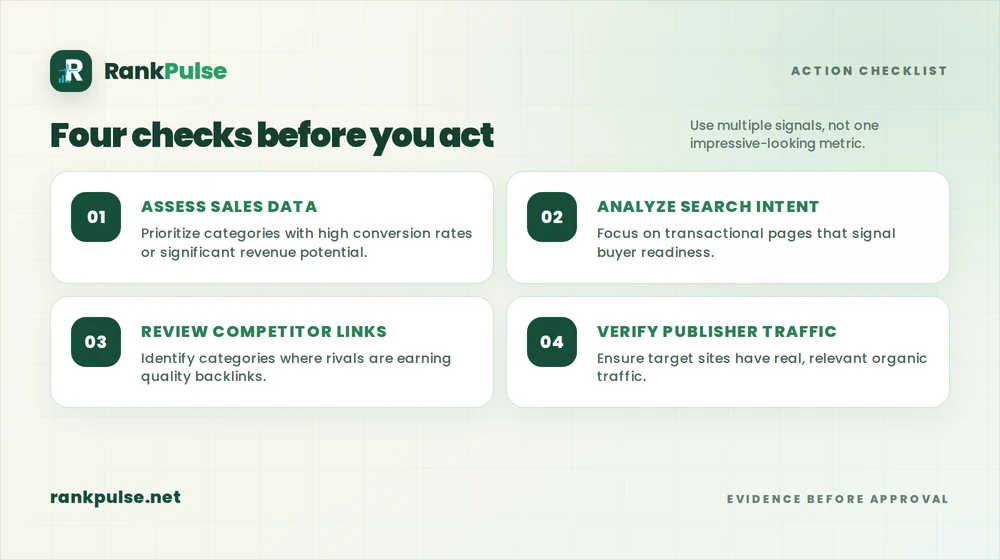
Start with sales data. Which categories bring in the most revenue? If one category makes $50K a month and another makes $2K, your link budget should reflect that gap.
Layer in search intent next. A transactional category like "buy blue running shoes" signals buyer readiness. An informational category like "blue running shoe reviews" brings traffic with different intent. Both matter, but they need different strategies. Transactional categories usually deserve heavier link investment because they're closer to revenue.
Check what competitors are doing. Use a tool that tracks competitor backlinks and filter for category pages. If three rivals are getting links to their "commercial real estate listings" category and you're not, that's a signal the category is competitive and worth your budget.
Forecast traffic potential carefully. A category with zero current ranking visibility but 5,000 monthly searches is a growth play. A category already ranking third with 100 monthly searches may not justify the spend. You're hunting for the sweet spot: real search volume, competitive but winnable rankings, and a clear conversion path.
Vetting publishers before you place a link
This is where most people cut corners.
Domain Authority or Domain Rating alone means nothing. I've seen DA 60 sites with zero real traffic. I've also seen DA 45 sites sending qualified visitors every week. Check actual traffic using SimilarWeb or Ahrefs. If a site claims 50K monthly organic sessions but the tool shows 5K, something's off.
Editorial relevance beats vanity metrics. A link on a tech blog to your furniture category is weaker than a design blog link. Google reads context. If the publisher's audience matches your customers, the link carries more weight.
Ask how the publisher handles link qualification. If they use rel="sponsored" or rel="nofollow," that's transparent and correct. Google's spam policies state that paid links passing ranking credit can be considered link spam unless qualified with rel="sponsored" or rel="nofollow" where appropriate. A publisher who refuses these attributes or seems confused is a red flag. You want partners who understand proper qualification.
Avoid sellers who promise big metrics without proof. Request traffic samples and check their previous work. Across a 550-site sample from our curated inventory, the median guest post price was $60, with 83% of sites at $100 or less. If someone charges $500 for a placement with no traffic proof, keep walking.
Building a profile that actually holds up
Anchor text diversity matters for category pages. You can't link to every category using the exact category name. Vary it. Some branded, some partial match, some generic like "read more" or "learn more." This looks natural and reduces over-optimization risk.
Internal linking should support your external links. If you earn a link to your "winter coats" category from a fashion publisher, make sure your internal linking strategy points to that page from related pages within your store. This reinforces the signal and helps distribute link equity naturally.
Track performance over time. Set up monitoring in Google Search Console to see which category pages gain impressions and clicks after links go live. This is your real feedback loop. If a category page stays flat for three months after earning a link, that's a learning moment. Maybe the category wasn't as valuable, or maybe the link source was too weak. Either way, you adjust. Our guide on guest posting without SEO waste covers monitoring and adjustment in detail.
What vetted inventory actually looks like
When evaluating publishers for category page placements, look for real numbers. Our curated inventory includes high-traffic news sources with strong domain ratings and millions of monthly organic visitors. That's not just a domain with a high score, it's a site with real, measurable traffic.
We also work with niche specialists like healthcare publishers. For a furniture or apparel retailer, those might not fit. For a telehealth or wellness category, they're valuable because the audience aligns.
Our 550-site sample shows a median Domain Authority of 49, with 37% of sites at Domain Rating 70 or higher. Pricing reflects quality. Paying near median rates for vetted sites with real traffic and editorial relevance beats chasing cheaper, unvetted links.
Frequently asked questions
How do I know if a category page can actually rank with link building?
Check search volume and current ranking position. If the category has 1,000+ monthly searches and you're ranking outside the top 50, links can help. Below 500 searches, the ROI gets thin unless conversion value is very high. Look at the top 10 results. If they're all major retailers with massive domain authority, links alone won't move you. If smaller brands are ranking, you have a shot.
What's a realistic budget for links to a single category page?
It depends on competitiveness and conversion value. For a high-revenue category in a crowded space, $1,500 to $3,000 for 3–5 quality links over six months works. For a newer or niche category, $300 to $800 for 1–2 links fits better. Link quality to expected return. A category converting at 3% with a $50 average order can justify a bigger budget than one at 0.5% conversion.
Can niche edits help category pages rank faster?
Yes, if the edit is genuinely relevant and on a site with real traffic. A niche edit places your link in an existing article instead of a new guest post. For category pages, this works when the article discusses products your category covers. The risk is that a poorly placed edit looks unnatural. Make sure the publisher understands context and relevance before committing.
What if my category page has almost no search volume right now?
Build links anyway if conversion potential is high. Some categories are low-volume by nature. Specialty products, local categories, and brand-specific pages often have small audiences but high buyer intent. If someone searches for exactly what you sell, they're close to purchase. Links help these pages surface and let Google understand your site structure better. Start smaller. One link from a relevant source can establish credibility and get the page crawled more often.
How does Google view paid links to category pages?
Google treats paid links the same regardless of page type. If the link passes ranking credit and isn't qualified with rel="sponsored" or rel="nofollow," Google considers it potential link spam. Google advises qualifying outbound links to distinguish between different relationships and prevent passing ranking signals for unnatural or manipulative links. When working with publishers on guest posts or sponsored placements, confirm they're using proper qualification. This protects both you and them.
Should I build links to product pages or category pages?
Both work, with different strategies. Category pages are easier to build links to because they cover broader topics with wider appeal. A journalist might write about "best running shoes" and link to your shoe category. Linking to a specific product is harder. Start with category pages to establish domain authority and topical relevance. Once those rank well, product page links become easier. Our guest posting service can help identify which pages in your structure are most link-worthy based on your goals.
Data note: Statistics in this article come from a 550-site sample from our curated inventory and represent that sample specifically.
RankPulse sells guest post placements and link placements on vetted publisher sites. Paid links are paid links under Google's policies. We focus on vetting for editorial quality, real traffic, and audience relevance to reduce risk and improve performance, not to guarantee ranking movement.

Level 2 Fiverr seller with a 5.0 rating. Has reviewed thousands of publisher records to build a curated placement inventory since 2024. Fiverr profile · zahid@rankpulse.net