RankPulse Blog
Budget Guest Posting: Vetted Links Without Wrecking Your SEO
You Bought Cheap Links Before and They Didn't Work
Your traffic never moved. Or the numbers looked good on a spreadsheet but your rankings stayed flat for months. Maybe you got a manual action notice and had to disavow a whole batch. If you've bought budget guest posts and felt like you wasted money, you're not being paranoid. A lot of budget link sellers really are selling you nothing, or worse, something that hurts you.
Here's the thing: good links at realistic prices do exist. They're just not the ones shouting the loudest.
- Across a 550-site sample, median guest post pricing sits at just $60, and 83% of vetted sites price at $100 or less.
- Price alone tells you nothing. A $50 link from a real, traffic-backed site beats a $200 link from a spam network every time.
- The sites worth buying from stay quiet. They don't promise rankings, they show their traffic data, and they care who links to them.
- Google's policy on paid links is clear: if the link passes ranking credit, it needs rel="sponsored" or rel="nofollow" qualification or it's spam.
Why Budget Links Fail So Often
Two things usually happen when you buy a cheap package.
First, the metrics are fake. You get a site with a Domain Authority (DA) of 45 that claims traffic, but you run it through a traffic checker and see 200 monthly visitors from bots. The domain authority number came from a tool that hasn't been updated in years. The publisher bought the domain after it lost relevance, so those metrics are borrowed from its past life.
Second, the site itself doesn't matter. Your guest post lands on a page with zero editorial standards, surrounded by auto-generated content and ads that load for five seconds before the actual article appears. Google crawls it, files it away, and the link does nothing for you. Worse, if enough links like that point to your site, the algorithm starts questioning your link profile.
What Actually Matters in a Budget Placement
Price is easy to see. Traffic is what counts.
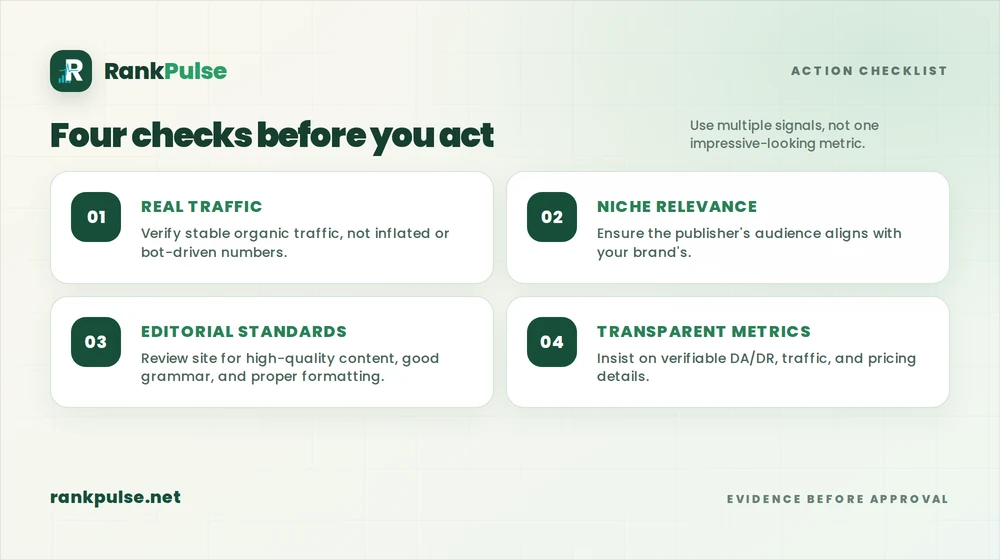
When I vet a site, I don't start with domain authority. I look at whether real people visit it. I check if the traffic is steady across months, whether it comes from the right countries, and whether the content actually gets shared. A site with 8,000 monthly organic visitors and a DA of 70 is worth buying from. A site with a DA of 85 and 300 bots is worthless.
Niche alignment comes next. If you sell accounting software and I sell you a link from a fitness site, that's a wasted placement. The audience is wrong. Google's systems care about this too. A link from a relevant site, even a smaller one, sends a clearer signal than a link from a big site about something unrelated.
Editorial quality is the third filter. Can you read the published article without cringing? Is the grammar clean? Do the paragraphs make sense? If your guest post sits next to AI-generated listicles and keyword-stuffed content, you're getting guilt by association.
The Numbers on Budget Placements That Work
Let's be specific.
Across a 550-site sample of vetted publishers, the median guest post price is $60. That's not a rounded number. That's what real, traffic-backed sites with genuine editorial standards charge when they're not desperately chasing volume.
In that same sample, more than a third of the inventory has a Domain Rating (DR) of 70 or higher. This isn't a race to the bottom. These are actual publishers that do work, get traffic, and have enough editorial control to say no to bad submissions.
Take mundoapprd.org: DA of 78 (from Moz) and DR of 81 (from Ahrefs), 7,900 organic visitors per month, guest posts at $50. Or officialbusinessnews.com: DA of 78 and DR of 82, 16,700 monthly visitors, also at $50. These aren't household names. They're not charging $500 or promising you'll rank in a week. They're solid placements at honest prices.
How to Spot a Real Site vs. a Waste of Money
Run your own checks before you commit.
Pull the domain into Ahrefs, SEMrush, or Moz. Look at the organic traffic chart. Is it flat for six months? Is it a spike that disappears? Flat traffic for six months usually means the numbers are earned, not bought. A single spike that fades often signals someone gamed their metrics, and you can't trust anything else they tell you.
Visit the site yourself. Read two or three published articles, not guest posts. Actual publisher content. Is it readable? Does it cite sources? Are the comments spam or real? If the site looks like it was designed in 2008 and populated with auto-generated content, close the tab.
Ask the publisher direct questions: How much organic traffic did you get last month? Can you show me a traffic screenshot? Who've you published for before? A legit publisher answers these without hedging. If they dodge or try to upsell you to a "premium" verification, they're hiding something.
Google's Rules, Straight Up
Here's what you need to know about paid links.
Google's spam policies are explicit: paid links that pass ranking credit are link spam unless they're marked with rel="sponsored" or rel="nofollow". If you buy a link and it's dofollow without disclosure, you're violating policy. The publisher should tell you upfront whether the link will be qualified.
This doesn't mean you can't buy guest posts. It means the link has to be transparent about what it is. A publisher who marks paid links properly and has real traffic is playing by the rules. A publisher who hides the fact that they're being paid and passes full ranking credit is not.
Your job is to ask. Most ethical publishers will qualify the link or be upfront about it. If they won't, don't buy from them.
Building a Strategy That Actually Works at Budget Prices
Cheap doesn't mean compromised if you're selective.
Buy from 5–8 vetted sites instead of 20 random ones. Spend more time on vetting, less time on volume. A single link from mundoapprd.org will move your needle more than five links from networks that look like they were assembled in a garage.
Diversify by niche relevance, not by price tier. Buy from sites in your industry at $50, $100, and $150. A mix across relevant publishers is stronger than clustering everything in one price bucket.
Build a long-term relationship with 2–3 publishers. If a site publishes your first guest post and it gets real traffic, ask them about a second placement three months later. Repeat placements on trusted sites look more natural than a one-off link dump.
Common Mistakes People Make at the Budget End
Comparing price to DA or DR as if they're connected.
They're not. A site with DA 72 and 300 monthly visitors is not better than a site with DA 58 and 12,000 monthly visitors. The second one is stronger because it has real audience reach. Buy based on traffic, not domain metrics.
Treating the publisher's metrics as fact without checking them.
A publisher can tell you whatever they want. Run independent verification. If their numbers don't match what you find in Ahrefs or Ubersuggest, ask why. If they can't explain the gap, move on.
Assuming a cheaper link is lower quality in ranking power.
It's not. A $50 link from a relevant, traffic-backed site with good editorial standards carries the same ranking signal as a $300 link from the same type of site. The price difference usually reflects how much the publisher spent acquiring you as a client, not link quality.
Buying without reading the final published article.
Some publishers will publish your article then change the anchor text, move your link lower in the body, or surround it with affiliate spam. Before you pay the balance, ask to see the published article. If anything looks off, ask for a revision before you sign off.
When to Walk Away
A few red flags warrant a hard pass.
If a publisher promises rankings. No one can promise that, and anyone who does is either lying or planning to manipulate results in ways that'll hurt you later.
If they can't show you recent traffic data or get defensive when you ask for it. Transparent publishers have nothing to hide.
If they bundle your link with dozens of others in a single article. That's a sign they're treating links like commodities, not editorial placements. Your article should stand on its own merit.
For more guidance on validating your links after they go live, see our post on guest post placement verification after publication.
FAQ
Can I actually get a good link for under $100?
Yes. In a 550-site sample of vetted publishers, most sites price at $100 or less, and the median guest post costs $60. The key is looking for sites with real traffic, editorial standards, and niche relevance instead of chasing the lowest price. A $50 link from a site with 8,000 monthly visitors beats a $200 link from a site with 500 visitors.
What makes a budget link resilient instead of risky?
Resilience comes from three things: real, stable traffic (not bots or spikes); editorial quality (the site looks professional and the content is readable); and niche relevance (your industry or audience aligns with theirs). It also means the link is properly qualified if it's paid, either with rel="sponsored" or rel="nofollow" where Google's policy requires it. A cheap link from a real site with an audience is lower-risk than an expensive link from a network Google has already flagged.
How do I know if a publisher is inflating their traffic numbers?
Run independent checks in Ahrefs, SEMrush, or Ubersuggest and compare their claims to what the tools show. Look at the traffic chart itself: stable traffic across six months usually means it's earned, while big spikes that disappear often signal artificially boosted numbers. Ask the publisher for a traffic screenshot from Google Analytics or Search Console. If their claimed numbers don't match what independent tools show, ask them to explain the gap. If they dodge the question, move on.
Will a $50 link have the same ranking power as a $500 link from the same site?
Yes, if they're both from the same publisher. The ranking signal comes from the site's authority, relevance, and traffic, not what you paid. Price differences usually reflect the publisher's cost of acquisition, marketing spend, or how selective they are. Two links from the same site at different price points carry the same ranking weight.
What should I ask a publisher before I commit to a guest post?
Ask for last month's organic traffic and whether they can show a screenshot. Ask who they've published for recently. Ask whether the link will be dofollow, nofollow, or marked as sponsored. Ask to see the article before you pay the full balance. Ask about revisions if you find an issue with placement or context after publication. A publisher who answers clearly and without defensiveness is worth buying from.
Should I worry about Google penalties from budget links?
Penalties come from low-quality link farms or link schemes, not from reasonable pricing. A link from a real publisher with real traffic and proper disclosure is far lower-risk than a link from a network that's been flagged before. Your risk comes from buying from disreputable sellers, not from what you paid. Vet the publisher, check their traffic, and verify the link is properly qualified. If you do that, a budget link is as safe as an expensive one.
Data note: Pricing and domain rating statistics are from our tracking of 550 vetted publisher sites. Paid links that pass ranking credit require proper qualification with rel="sponsored" or rel="nofollow" under Google's policies.

Level 2 Fiverr seller with a 5.0 rating. Has reviewed thousands of publisher records to build a curated placement inventory since 2024. Fiverr profile · zahid@rankpulse.net