RankPulse Blog
Link Campaign Flat Rankings: Diagnosing a Stalled Strategy
Your Link Campaign Stalled, and You're Wondering If It's the Links
Six months in, the rankings haven't budged. You built links. You followed the playbook. But your target keyword is stuck in the same spot it was when you started, and now you're asking if the links themselves were ever going to work. That's the right question. Most link campaigns fail silently not because the strategy was wrong, but because the links being built were weak, misaligned, or buried so deep in low-traffic sites that Google barely noticed them.
- Most stalled campaigns collapse under their own low-quality links, not time constraints.
- Link authority alone (DA/DR scores) doesn't predict real editorial impact or Google trust.
- Paid links that pass ranking credit without rel="sponsored" or rel="nofollow" tags create policy risk and often see diminishing returns.
- Niche relevance and actual reader traffic matter more than metrics. Audit your existing links first before buying new ones.
Why Your Link Building Might Be Stalling Out
There's a gap between what people promise when they sell you a link and what actually happens when Google crawls it. A link from a domain with a decent Domain Authority score looks good in a spreadsheet. But if the site has no real user trust, that link will sit on a dead page, never get clicked, and signal nothing to Google.
The first trap is volume. You bought 20 links because the math seemed simple: more links equals higher ranks. But if half of those placements are on low-traffic, low-relevance sites, they're not compounding your authority. They're diluting it.
Google's crawlers spend less time on weak pages, so your link gets buried. It gets less visibility, less flow, less credibility.
The second trap is relevance confusion. A link from a tech blog to your SaaS product sounds relevant—until you realize that 'tech blog' also covers gaming, cryptocurrency, and everything else. Google sees through that. The blogger didn't pick you because you belong in their world. They picked you because you paid.
Here's what most link sellers won't admit: Google's spam policies explicitly state that paid links passing ranking credit can be considered link spam unless they're tagged with rel="sponsored" or rel="nofollow". Many cheap link packages skip this entirely. That doesn't just hurt your rankings over time. It can trigger manual review if Google's team spots a pattern.
Diagnosing Underperforming Links: The Quality Check
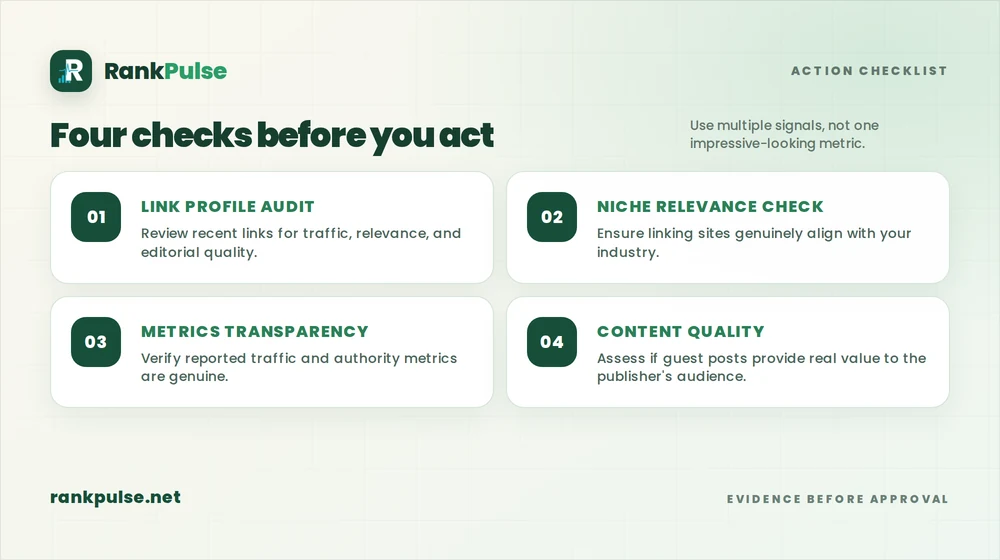
Pull your recent backlinks from Ahrefs or Semrush. Sort by domain authority and visit each site. Does it look like a real publication or a link-selling operation? Can you find a real author byline? Is there a comments section with actual reader engagement?
Check if the site gets organic traffic or if it's a thin content farm that only exists to rank affiliate links and host paid guest posts.
Now look at the article where your link lives. Does it solve a real problem or read like a thinly-veiled ad? If your link is the only outbound link in a 500-word post, red flag. If the post is 800 words of actual value with 5-6 relevant outbound links, your placement has editorial credibility. Google evaluates context. Low-value filler buries links. Trusted articles embed them naturally.
Check traffic patterns using your analytics or Similarweb. While authority metrics might suggest a DR 65 site is superior, if it only has 500 visitors a month, a DR 45 site with 5,000 visitors is often more valuable. Authority metrics lie. Real traffic doesn't.
Count your anchor text. If 70% of your links use your exact target keyword, they look unnatural. Google notices. A strong link profile has varied anchors: brand name, partial match, related phrases, and naked URLs. Keyword-stuffed links are a red flag.
Are Your Campaign Goals Aligned with Reality?
You're competing against 200 sites, each with 100+ backlinks. Your target keyword has 5,000 monthly searches. You have 20 links and six months. Those numbers don't add up. That's not a campaign failure—that's math.
Is your link strategy actually targeting the right anchor keywords and search intent? Run a quick search for your target term and check the top 10 results. Look at the anchor text in their referring domains. Are they mostly branded, keyword-heavy, or mixed? Mirror that pattern.
Building a Resilient Link Strategy for the Next Phase
A stalled campaign teaches you exactly what to do next. You've already spent the money and time. Use that data.
When vetting new placement opportunities, require transparency on two things: real traffic and real editorial metrics. Don't accept "estimated" DA or DR from a link seller. Ask them to show you Google Search Console data (anonymized is fine) or Similarweb traffic patterns. If they can't or won't, that's a sign the site doesn't have real visibility.
Across a 550-site sample, the median DA is 49 (Moz) and median DR is 63 (Ahrefs). Thirty-seven percent hit 70 or higher. Authority alone doesn't guarantee results. But pricing tells the real story: 83% of these sites sell for $100 or less. If a seller asks $300 for a DR 65 link, ensure the site's traffic and relevance justify that premium, as 83% of our sample prices at $100 or less.
Niche relevance is non-negotiable. A placement on a site clearly in your industry is worth 3-5 placements on generic "business blogs" that cover everything. If you sell ecommerce software, a link from a real ecommerce blog beats a link from a general SaaS publication. Google's systems recognize topical relevance. Sites in your space have readers who are actually your potential customers.
After you place new links, verify them. Check our post on guest post placement verification after publication to confirm each placement went live as promised, on the right URL, with the right anchor text, without nofollow tags added after the fact.
FAQs About Stalled Link Campaigns
How long should I wait to see results from new links?
Most new links take 4-8 weeks to index. In a competitive niche? 8-12 weeks before you see ranking impact. If 12 weeks pass and nothing moves, the links are weak. Check if those sites even have real organic traffic and topical relevance to your work.
Can a Google update affect my link campaign's impact?
Google issues spam updates periodically designed to combat link spam and other manipulation tactics. If your link profile includes unqualified paid links or links from low-quality sites, an update could reduce their impact. The best protection is building links from real editorial sources with genuine traffic and relevance, not relying on cheap volume.
What metrics should I prioritize when vetting new link opportunities?
Prioritize real traffic over authority scores. A site with a DR of 50 and 3,000 monthly visitors is more valuable than a DR 70 with 200 visitors. Check niche relevance: is this site a real publication in your industry? Verify the anchor text is natural and the article provides real value. If all three checks pass, the link will likely contribute to your rankings.
Should I remove or disavow my existing stalled-campaign links?
Not automatically. If the links are from real, legitimate sites with genuine traffic, they're still helping you even if results are slow. Removing them wastes money. If you've identified links from obvious spam or low-quality farms, disavow them to protect yourself from manual review risk. Gradually replace weak links with better ones instead of blowing up your entire profile.
Disclosure: RankPulse sells link placements across our curated inventory. Paid link placement should comply with Google's policies, including rel="sponsored" or rel="nofollow" attribution. Data on inventory metrics and pricing in this article comes from our tracking of a 550-site sample.

Level 2 Fiverr seller with a 5.0 rating. Has reviewed thousands of publisher records to build a curated placement inventory since 2024. Fiverr profile · zahid@rankpulse.net