RankPulse Blog
Local SEO: When Citations Outrank Editorial Guest Posts
The Real Problem With Local Link Building Strategy
You've probably bought guest posts that looked solid on paper, got them delivered with impressive numbers attached, and watched your local rankings stay flat. Meanwhile, a competitor spending half your budget seemed to own the map pack without publishing a single article. That gap isn't about content quality. Local business link building works on different rules than national SEO. You need to know when citations move the needle faster than guest posts.
Local businesses play by different ranking signals than national brands. Proximity, city relevance, and NAP consistency matter most—not high domain authority.
- Citations (NAP consistency across local directories) often deliver faster local ranking lift than guest posts for small-to-medium businesses.
- Guest posts still matter, but only when they're niche-relevant and placed on sites with real authority and traffic.
- Across a 550-site sample, our curated inventory shows a median DR of 63 and median guest post price of $60, but vetting for relevance is what separates wasted spend from actual wins.
- Build your citation foundation first. Guest posts work better when citations are already clean and consistent.
Source note: For Google policy or update references, this article uses Google documentation and treats unsupported update-target claims as audit guidance, not confirmed targeting.
Source note: For Google policy or update references, this article uses Google's Search Status Dashboard and treats unsupported update-target claims as audit guidance, not confirmed targeting.
Why Local SEO Isn't Just National SEO on a Smaller Scale
Google treats local queries differently. A search for "plumber near me" or "accountant in Denver" activates the local pack, which uses signals national rankings don't. Proximity, city relevance, and NAP consistency matter most.
Most link-building advice chases national authority: high-DR features, published articles, brand mentions. That's effective for SaaS and ecommerce because they compete nationally. Local plumbers and dentists compete in their zip code, so those signals barely move the needle.
Citations are foundational. They tell Google who you are, where you are, and whether you're trustworthy there.
What Citations Actually Do (And Why They're Often Underrated)
A citation is just a mention of your NAP—business name, address, and phone number—on another website. It doesn't need to be a link.
Citations do two things: they signal to Google that you're real and stable, and they help review sites trust your data. When your NAP is accurate everywhere, those platforms share correct information about you—and that improves your rankings.
Structured citations (Google My Business, Yelp, Apple Maps, industry-specific directories) carry more weight than unstructured mentions. Most local businesses fail at this step: they've got listings in some directories and contradictory data in others, with no system to keep it clean.
Citations build trust in Google's eyes.
Editorial Guest Posts: Still Valuable, But With Conditions
A guest post on a site tied to your industry (industry publication, local news outlet, professional association) does build authority. It also drives referral traffic and brand awareness, which are real benefits.
Here's the catch: authority without clean citations won't move your local pack rankings. Fix the NAP mess first.
Where guest posts shine is niche relevance. An accountant writing for a small business publication read by local entrepreneurs beats one on a massive finance blog, even if that blog has 10x more authority. Audience match matters more than domain strength for local rankings.
In our 550-site sample, sites with real traffic in the local business niche had a median DA of 48—and they beat flashy, high-authority options because your customers actually read them.
Citations Versus Guest Posts: When to Prioritize Each
If your NAP is inconsistent across directories, fix citations first. They're cheaper, faster, and directly move rankings.
This is the priority order that works:
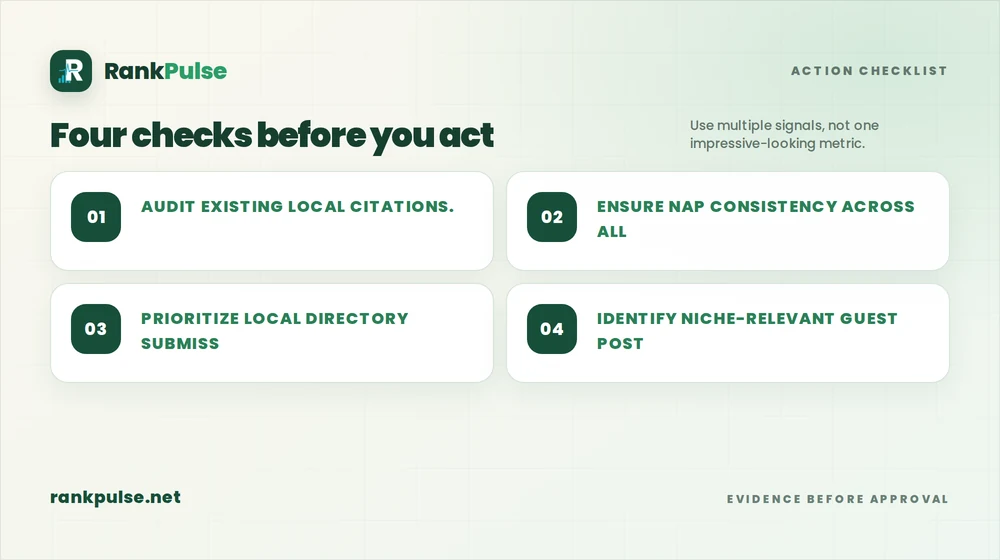
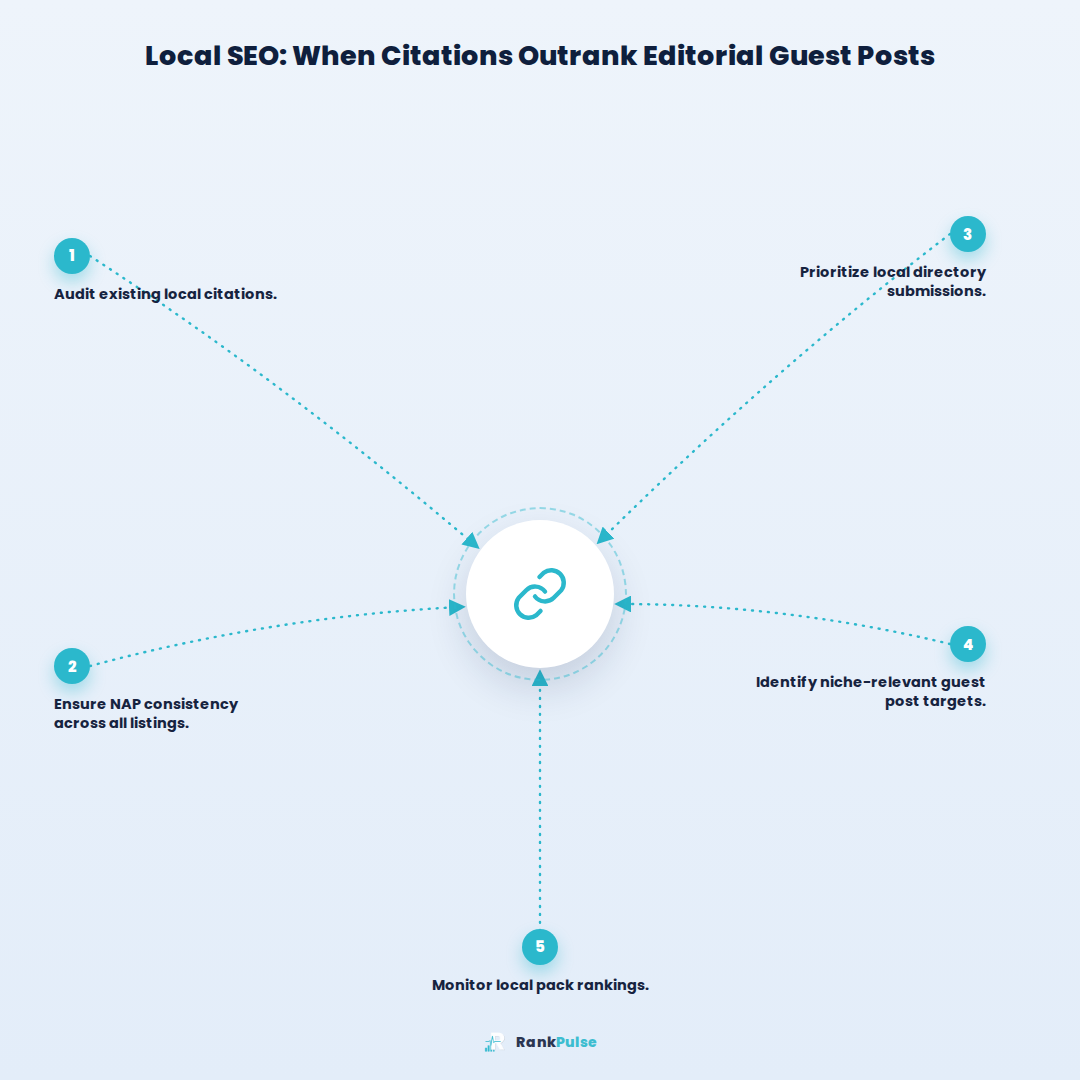
- Audit your existing citations. Check Google My Business, Yelp, Apple Maps, industry directories, and the biggest local aggregators in your space. Log every inconsistency: wrong phone number, outdated address, missing hours.
- Clean and standardize. Make your NAP identical everywhere. This alone usually bumps local pack positions within 2-4 weeks.
- Expand into missed directories. Industry-specific sites, chamber of commerce listings, trade associations. Your target audience looks at these.
- Then pursue guest posts. Only after your citation foundation is solid should you invest in editorial placements. Otherwise you're wasting placement budgets on authority that won't translate locally.
Once citations are locked in, guest posts shift purpose. They build broader E-E-A-T signals, drive referral traffic, and establish you as credible in your niche. A local business with clean citations and two solid posts beats a competitor with 10 bad ones and messy NAP data.
The Real Cost: Spotting Inflated Metrics and Wasted Spend
In our 550-site sample, guest post prices range from $30 to $1,520, with a median of $60. In the same sample, 83% of sites in our curated inventory are priced at $100 or less.
The real barrier is discipline. Don't buy from cheap sites claiming high domain authority unless they show you traffic proof.
A good placement has four markers: real traffic, editorial review before publishing, niche relevance to your customers, and transparent metrics. Vetting takes time upfront. It saves money and frustration later. For more context on evaluating link quality, see our guide to budget guest posting without wrecking your SEO.
What Quality Actually Looks Like in Numbers
In our 550-site sample, the business niche shows a median price of $65 with a median DA of 48. Those sites are real, they have actual traffic, and they're relevant to local business audiences.
Transparency matters more than flashy metrics—a site showing traffic sources and visitor trends beats a high-DA ghost town. When vetting guest post targets, ask for three things:
- Monthly traffic from Google Analytics or similar, trended over at least 6 months.
- Organic traffic specifically, not just total traffic.
- Editorial review process: does a human check submissions before publishing?
- Previous client work: examples of published posts so you can see quality and relevance.
- Author byline policy: can you include your name and credentials, or does it get buried?
Sites that answer these questions are rare. They're worth the cost. Vendors dodging them seem cheap at first, then waste your money.
Building Your Local Link Strategy: Step by Step
Start with citations.
Pull a list of every directory where you might already be listed: Google My Business, Yelp, Apple Maps, industry associations, state boards, the chamber, regional aggregators. Log the NAP for each. If inconsistent, fix it.
Standardize everything to match your Google My Business listing (phone, address format, description). A weekend of work, no money spent. Submit to directories you're missing, but not everywhere. Find 5-10 where your audience actually looks. Plumbers belong in contractor and home services directories; divorce attorneys in legal and local business listings.
Monitor your local pack rankings for 3-4 weeks. If rankings move, your NAP was the issue. If not, you need authority, and that's where guest posts help.
Once citations are stable, build a short list of niche-relevant guest post targets with real traffic in your industry. Pitch three to five. Spend 70-80% on citations first. Once solid, put 20-30% toward guest posts. Tight budget? Citations only.
Track local pack rankings monthly to see which placements move the needle, then double down on what works.
Why Vetting Matters More Than You Think
Bulk link packages waste money because ten posts on spammy sites produce no ranking movement.
Google's policy is clear: paid links need rel="sponsored" or rel="nofollow" to avoid spam flags. If a vendor doesn't disclose the payment, you inherit the risk. A site using rel="sponsored" is transparent and compliant; one that doesn't is cutting corners.
Vetting doesn't take weeks. Ask three things: Can they show traffic, do they have an editorial process, and are previous placements good and visible? If they answer yes to all three, they're real.
Data note: All inventory metrics in this article come from our tracking of a 550-site sample in our curated inventory.
Disclosure: RankPulse sells guest post placements on a curated inventory. Paid links are paid links under Google's policies. Our approach focuses on vetting for relevance, traffic verification, transparent metrics, and editorial standards as a lower-risk decision-making framework. This is not a guarantee of ranking movement. Learn more about our guest posting service to see how we vet every placement for quality and relevance.
FAQ: Local Link Building Clarity
How many citations does a local business actually need?
Start with the major platforms: Google My Business, Yelp, Apple Maps, and your industry association's directory. That's four critical citations. Add five to ten more in directories where your target audience actively searches. An accountant should prioritize business directories and tax professional networks. A plumber should prioritize contractor and home services sites. Quality and relevance beat a massive list of obscure citations.
Can paid guest posts cause a Google penalty?
Google's guidance on qualifying outbound links makes clear that paid links need rel="sponsored" or rel="nofollow" to avoid spam flags. If a vendor doesn't disclose the payment, you inherit the risk. Google penalizes link networks and spam farms, not individual businesses. Safety hinges on proper disclosure with rel="sponsored" or rel="nofollow" and avoiding spammy practices.
What's the ideal budget split between citations and guest posts?
Spend 70-80% on citations first. They're direct ranking fuel. Once solid, put 20-30% toward guest posts. Tight budget? Citations only.
How do I actually know if a site has real traffic?
Ask the vendor to show you data from Google Analytics, SimilarWeb, or Ahrefs. Traffic should be trended over at least six months, not just a screenshot of today. Organic traffic matters most. Direct and referral traffic is lower-value for ranking purposes. 2,000 organic visitors beat 50,000 paid-ad visitors. If a vendor won't share traffic data, move on.
Should I focus on high-DA sites or niche-relevant sites for local guest posts?
Niche-relevant wins for local businesses. A guest post on a DA 48 site read by accountants in your state moves your local rankings faster than a post on a DA 72 general business blog. Domain authority matters for national ranking signals. For local rankings, audience overlap and relevance matter more. Choose sites where your actual customers spend time.

Level 2 Fiverr seller with a 5.0 rating. Has reviewed thousands of publisher records to build a curated placement inventory since 2024. Fiverr profile · zahid@rankpulse.net