RankPulse Blog
Competitor Link Gap: Build a Resilient Shortlist
Your Link Gap Report Is Worthless Without a Vetting Filter
You pull a competitor link gap analysis and get a spreadsheet of 400 sites. Half of them are mediocre, a quarter look spam-adjacent, and you have no idea which ones will actually move the needle. So you pick a handful based on Domain Authority alone, pay for placements, and nothing happens. The links land, the backlink profile looks fatter on paper, but traffic and rankings stay flat.
This is what happens when you skip the vetting step. A gap report shows you where your competitors have links that you don't. That's useful intel. But a raw gap report isn't a placement shortlist. It's a starting point that needs real filtering.
- Gap analysis finds opportunities. Vetting turns them into actual placements worth the spend.
- 37% of vetted publisher inventory has DR 70 or higher, but authority metrics don't tell you if a site has real traffic or fits your niche.
- Build a shortlist by layering domain strength, traffic volume, editorial fit, and cost-efficiency instead of picking sites in isolation.
- A $30 placement on a site with 91K monthly visitors and real traffic beats a $820 placement on a site that looks big but isn't aligned with your audience.
Source note: For Google policy or update references, this article uses Google documentation and treats unsupported update-target claims as audit guidance, not confirmed targeting.
Why Raw Metrics Hide the Real Problems
A site can have a Domain Rating of 72 and still be garbage. I've seen it hundreds of times. High authority paired with no real traffic, no editorial standards, and a backlink profile full of exact-match anchor spam.
Here's what usually happens. A publisher buys expired domains, rebuilds them with thin content, and sells guest posts cheap. Their backlinks look legitimate because they're old. But the traffic is fake, the audience doesn't exist, and Google's spam systems eventually catch it. When that site gets hit, your links sit there doing nothing.
Google's spam policies explicitly warn against link manipulation that violates editorial integrity. Paid links that pass ranking credit need rel="sponsored" or rel="nofollow" tags where appropriate. If a site indiscriminately accepts dofollow guest posts from any industry at any price, that's a red flag it's not vetting editorial fit.
The gap report doesn't tell you this. It just shows you: competitor has link from site X, you don't. You have to dig deeper.
The Real Filters: Traffic, Fit, and Spam Signals
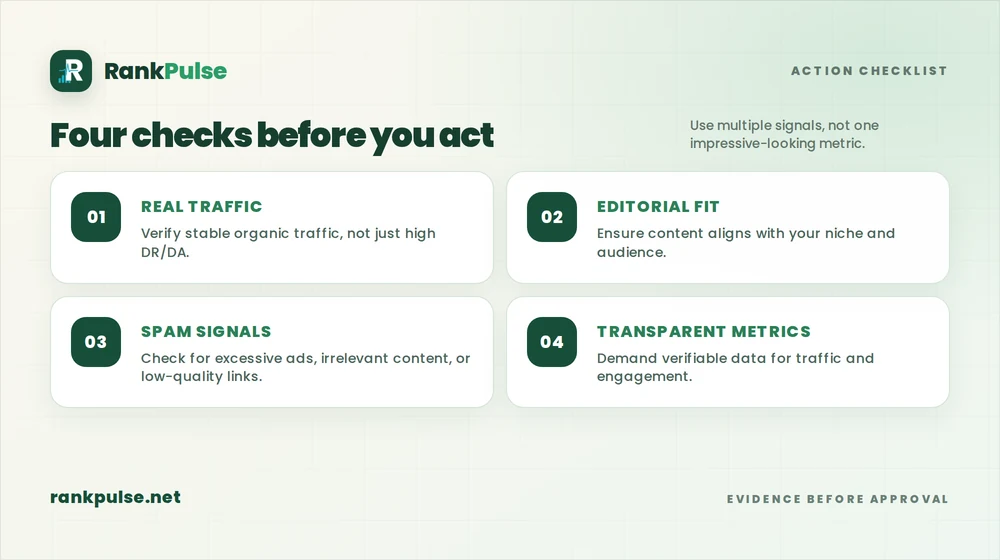
Start with traffic you can actually verify. Use Similarweb or Semrush to pull organic traffic data over 6 to 12 months. Real sites show stable or growing traffic. Fake ones show spikes that vanish or flat numbers that don't match the claimed authority.
Next, check editorial fit. Does the site cover topics in your industry? Do the articles sound like humans wrote them with real expertise, or are they thin keyword templates? Read three to five recent articles all the way through. If you can't follow the logic or the writer doesn't seem to know the subject, that's a red flag.
Scan for spam signals. Excessive ads, unrelated content silos, or a backlink profile full of spammy anchors all point to a low-effort operation. Pull the referring domain quality using Ahrefs or Moz. If most backlinks come from PBNs, redirect chains, or expired-domain farms, move on.
Finally, ask for proof. Request traffic screenshots or Google Analytics access from the publisher. A legit publisher will provide it. A sketchy one will dodge or make excuses.
Building Your Shortlist: Combining Gap Data With Quality Signals
Here's the actual workflow. Take your gap report. Cross-reference each site against the filters above. Eliminate anything that fails the traffic or editorial fit test. What's left is your candidate pool.
Now prioritize by value. Cost per placement matters, but it's not everything. A $30 guest post on a site with 91K monthly visitors and real traffic beats a $820 spot on a site that claims 900K visitors but has no real audience.
Real numbers from a 550-site sample show this clearly. Premiumtimesng.com has a DR of 78 and 906K traffic, but costs $820. Techradar.com has a DR of 72, 240K monthly traffic, and charges $110 per guest post. Both pass basic quality checks. If your budget is tight and audience overlap is similar, the second option gives you better ROI.
Wirecutter.com sits in the middle: DR 81, 320K traffic, $150 per placement. For most consumer niches, that's the sweet spot.
| Publisher | DR | Monthly Traffic | Guest Post Price | Value Signal |
|---|---|---|---|---|
| Techradar.com | 72 | 240K | $110 | Budget-friendly, solid authority |
| Wirecutter.com | 81 | 320K | $150 | High authority, accessible price |
| Niche-specific publisher | 80 | 85K | $170 | Strong domain, niche audience |
| Premiumtimesng.com | 78 | 906K | $820 | High-traffic flagship, premium cost |
For most SaaS or eCommerce brands, a mix of the first three outperforms the last one, especially if your niche has tight audience overlap with those smaller sites.
Vetting Saves You From False Economies
Cheap doesn't mean low-quality, and expensive doesn't mean high-quality. Vetting filters separate the two.
A site with median Domain Authority of 49 across a 550-site sample isn't automatically weak. Some of the best ROI comes from mid-tier publishers with real audiences. The median DR across that same sample is 63, which is healthy. And 83% of sites in that sample price at $100 or less, so quality placements are accessible without breaking budget.
The trap is picking sites that look good on paper but don't deliver. Your competitor might have a link from a site that charges $300 per post, has a DR of 75, and receives zero organic traffic. You don't want that link just because your competitor has it. You want links from sites where your audience actually shows up.
That's the difference between a gap analysis and a shortlist. A shortlist is built on places where you'll actually be read by people who matter.
Building Long-Term Publisher Relationships
Once you have a vetted shortlist, don't treat it as disposable. The best link-building strategy isn't one-off placements. It's recurring relationships with publishers who know your brand and your niche.
When you pitch a publisher, be honest about what you're looking for. You want a placement that genuinely fits their audience, which means you've read their site, you understand their tone, and your article adds real value. Publishers spot low-effort pitches instantly.
Share transparent metrics too. If you send traffic data, engagement rates, and audience demographics, they'll take you seriously and treat your placement differently. Over time, this builds into a sustainable acquisition channel. A publisher who knows your work might pitch ideas, offer better rates, or prioritize turnarounds.
FAQ: Your Link Gap Questions Answered
How do I spot a low-quality site hiding behind high metrics?
Check traffic volume first. If a site claims DR 75 but Similarweb shows less than 5K monthly organic visitors, the metrics are inflated. Real authority shows up in real traffic. Pull the top 10 backlinks using Ahrefs. If they're mostly from spammy domains or PBNs, the authority is borrowed, not earned. Read an article start to finish. If it doesn't make sense or feels machine-generated, the site isn't editorial.
What are the risks of building a shortlist purely from competitor link profiles?
Competitors might have links from sites for reasons unrelated to quality. Your gap report is a map of where they invested, not where they should have. A competitor in a different industry segment might get away with a placement that's misaligned for your audience. Or they might have old links from sites that were good five years ago but have declined since. Vet independently rather than copying their backlink profile.
Can a site with lower DA or DR still be a valuable placement?
Yes. A site with DA 45 and 50K real monthly visitors, perfect editorial fit, and an engaged audience is worth more than a DA 70 site with 2K traffic and audience misalignment. Domain authority and Domain Rating are one signal. Traffic, relevance, and audience behavior matter equally. Some of the best ROI placements come from sites in the DA 40 to 55 range because they're less competitive, more willing to work with partners, and their audiences are often more loyal than high-authority news sites.
A gap report is reconnaissance. A vetted shortlist is strategy. The difference is filtering. Spend the time to vet, and you'll stop wasting money on placements that don't move the needle.
Data note: Traffic and pricing figures from our tracking of a 550-site publisher sample. The 37% DR 70+ statistic and 83% sub-$100 pricing reflect this same inventory.
Need help building that shortlist with confidence? RankPulse vets placements on traffic data and editorial fit. Check out our guest posting service to see how we handle vetting, or review our pricing for what quality placements cost. RankPulse facilitates paid placements, and we advise clients on best practices for disclosure (e.g., using rel="sponsored") to align with Google's guidelines regarding paid links that pass PageRank. Want to talk through your specific gaps? Reach out.

Level 2 Fiverr seller with a 5.0 rating. Has reviewed thousands of publisher records to build a curated placement inventory since 2024. Fiverr profile · zahid@rankpulse.net