RankPulse Blog
SaaS Guest Posting in 2026: Vetted Sites & Real Traffic
Your guest posting strategy is quietly backfiring, and you don't know it yet
You've probably bought a few guest posts in the last year. The metrics looked solid. The traffic bump never came, or it did for two weeks then vanished. Now you're wondering if you wasted money or, worse, if those links are hurting you. SaaS guest posting in 2026 demands a different approach than what worked years ago.
This isn't paranoia. The guest posting industry for SaaS has become a minefield. Most of what's sold as "high-authority placement" is inflated metrics, poor audience fit, or links that won't survive the next Google update. But you can still win with guest posting in 2026. You just need to know what to look for and what to avoid.
- 83% of guest post pricing falls at $100 or less, yet many claim premium authority—a red flag for metrics inflation
- Real quality looks like steady organic traffic over months, not sudden spikes that disappear
- Editorial fit and audience relevance matter more than domain rating alone for SaaS conversions
- Vetted placements on tech sites median at $50 with a median DA of 46—quality is achievable at honest prices
Source note: For Google policy or update references, this article uses Google documentation and treats unsupported update-target claims as audit guidance, not confirmed targeting.
Why traditional guest posting tactics are failing right now
Five years ago, guest posting was simple: find a site with high DA, write decent content, get a dofollow link. Rankings moved.
That stopped working. Google's ranking systems now reward helpful, firsthand content and penalize low-effort link acquisition. They've also gotten better at spotting paid links that don't declare themselves. According to Google's spam policies, paid links that pass ranking credit without proper qualification can be treated as link spam. A careless guest post, or a cheap one disguised as editorial, carries real risk now.
Most guest posts sold today also fail on audience relevance. Your SaaS marketing tool gets placed on a generic "business blog" with 50,000 monthly visitors, but 48,000 of them are there for accounting tips. You get a link. You get no customers. Your backlink profile just got noisier.
What genuine quality looks like in a guest post opportunity
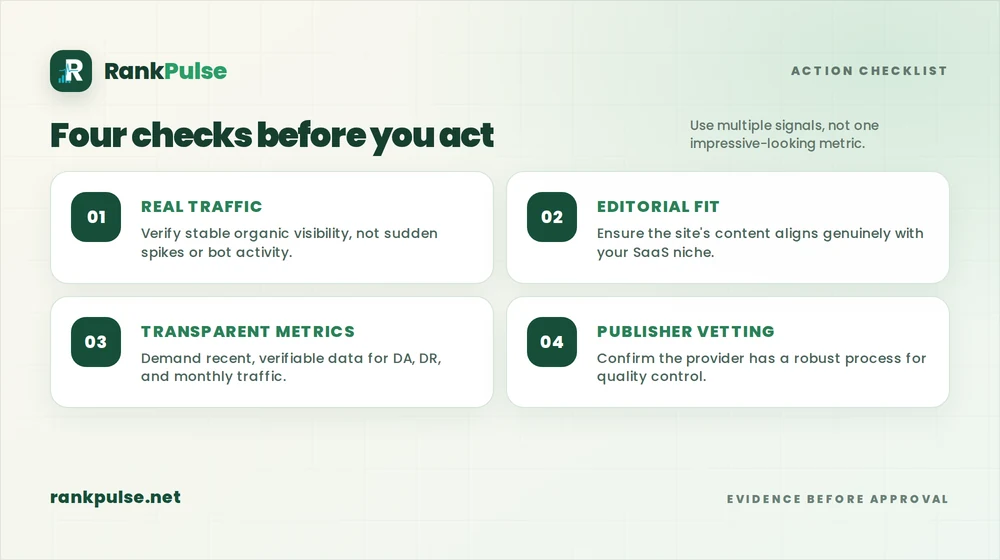
First, verify actual organic traffic. Not promised. Not estimated from Semrush. Actual, stable traffic flowing to that publication month after month.
Look at whether organic visibility is holding steady or spiking randomly. A site that gets 3,000 monthly organic visitors for six straight months is real. A site that jumped from 800 to 8,000 one month and dropped back to 1,200 the next? That's likely bought visitors or bot traffic. Real traffic compounds slowly.
Second, ask for editorial fit. Does the site's audience actually use SaaS like yours? If you sell project management software for construction crews and pitch to a SaaS generalist blog, you'll get the link but not the reader. Find publications whose typical audience overlaps with your customer profile.
Third, demand transparent metrics. A reputable provider should give you recent DA (Domain Authority) and DR (Domain Rating via Ahrefs) along with traffic data without hesitation. If they hedge, deflect, or show you old screenshots, that's your signal to walk.
Identifying truly vetted publishers for SaaS growth
A vetted publisher isn't just one with a high domain score. It's one where the provider has actually audited content quality, checked for bot traffic, confirmed audience makeup, and verified that previous guest posts didn't tank in rankings.
Start by asking what vetting process a provider uses. Do they check if the site's traffic is real? Do they review author guidelines? Do they read past guest posts to see if they're thin, keyword-stuffed filler or genuine articles? If they can't explain their process, they don't have one.
Across a curated sample of 550 publisher records, the median DR is 63. More useful than that single number is this: 37% of those sites sit at DR 70 or above, and they're not dramatically more expensive. Guest post prices in this inventory range from $30 to $1,520, with 83% priced at $100 or less. On tech-specific sites, the median price is $50 with a median DA of 46.
Quality isn't rare or impossibly expensive. It's just rare among sellers who prioritize volume over vetting.
How to evaluate pricing against what you're actually getting
A $30 post on a micro-site with 500 monthly visitors that claims DR 50? That's suspicious. A $1,500 post on a publication with real authority but zero audience overlap with your SaaS? That's expensive noise.
The useful question isn't "Is this cheap?" It's "Is this cheap relative to what I'm getting?" Compare the cost to traffic volume, DR, and audience relevance together. A $70 placement on a real tech blog with 5,000 monthly software engineer visitors beats a $300 placement on a generic business site every time, even if the generic site has higher authority.
Also ask what's included. Do you get editorial input? Will they run your article, or rewrite it into something generic? A provider who offers genuine editorial collaboration usually charges a bit more but delivers something that actually reads well and gets shared.
Building a backlink profile that survives algorithm updates
Your links need diversity. Not just in domain authority, but in how they're acquired. Some from niche sites. Some from broader tech publications. Some from digital PR. Some from resource pages and mentions. If 40% of your links come from guest posts, that's a concentration risk.
Mix in earned links from coverage, reviews, and genuine editorial mentions. The mix makes your profile look natural and harder to manipulate.
Content quality matters more than most SEOs admit here. A guest post on a high-authority site that gets zero clicks, shares, or comments will age worse than one on a mid-authority site that actually resonates with readers. An article that drives traffic and engagement to the host publication benefits both parties. Filler articles just sit there.
Google's current stance on paid links and how it affects your decisions
You need to understand what Google actually says about paid links. According to Google's spam policies documentation, paid links that pass ranking credit can be considered link spam unless they're qualified with rel="sponsored" or rel="nofollow" attributes.
This doesn't mean guest posts are forbidden. It means paid links without proper disclosure are a policy violation. A legitimate guest post program discloses the paid relationship. Some use rel="sponsored". Others use rel="nofollow". Transparency is what matters, not the link type itself.
When you're evaluating a provider or planning your own placements, verify that links are marked appropriately. If a seller promises dofollow links from paid placements without mentioning disclosure, that's a red flag.
Frequently asked questions about SaaS guest posting in 2026
How often should a SaaS company actually pursue guest posts?
One to two quality guest posts per month is reasonable for most SaaS companies targeting competitive keywords. A single high-relevance placement on a site your target customers actually read moves the needle more than five generic placements across unrelated publications.
What's the real difference between a guest post and a niche edit?
A guest post is a new article written specifically for a publication, assigned to you, and published under your byline. A niche edit is an existing article the publisher updates to include a link to you, typically in a resources section. Guest posts take longer and cost more. Niche edits are faster and cheaper, but the link sits in an ancillary section. For SaaS, guest posts tend to drive more traffic and feel more authentic. Most winning strategies use both. If you want to explore budget options, read our guide on budget guest posting without SEO wrecks.
Can guest posting still move rankings in super competitive SaaS niches?
Yes, if your link profile is diversified and your content is strong. Quality placements on relevant sites with real traffic to your target audience will improve your position over time.
How often should I audit paid links?
Audit paid links at least quarterly. After major ranking shifts, run a faster review focused on topical relevance, traffic trends, anchor text patterns, and publisher link policies.
Are paid guest posts allowed by Google?
Google treats paid links that pass ranking credit as link spam unless properly qualified with rel="sponsored" or rel="nofollow" attributes. Buyer due diligence should focus on relevance, editorial quality, disclosure policy, traffic, and reporting.
What should I ask a link vendor before ordering?
Ask for the live domain, DA, DR, estimated traffic, sample URLs, content standards, price, turnaround, and link attributes before payment.
Data note: Pricing and authority metrics in this article come from our curated sample of 550 publisher records.
About RankPulse: RankPulse sells guest post placements and niche edits to SaaS companies. Paid placements are paid links under Google's policies and require proper disclosure with rel="sponsored" or rel="nofollow" attributes where appropriate. Our vetting process prioritizes traffic verification, audience relevance, and editorial quality to reduce risk, but no placement strategy eliminates ranking volatility or provides specific outcomes.

Level 2 Fiverr seller with a 5.0 rating. Has reviewed thousands of publisher records to build a curated placement inventory since 2024. Fiverr profile · zahid@rankpulse.net