RankPulse Blog
Link Building for a New Domain: First 90-Day Strategy
Your New Domain Needs a Link Strategy, Not a Link Flood
You launched a site two weeks ago. The homepage ranks nowhere. Your competitor with a 5-year-old domain owns page one, and you're eyeing a $500 bulk link package to catch up fast. Don't do it. That approach will hurt you worse than help. When building links for a brand-new domain, strategy beats speed every time.
A brand-new domain has zero authority with Google. You'll be tempted to flood it with links right away, but that's backwards. Google's algorithm spots patterns. A domain that jumps from nothing to 50 links in two weeks looks rigged—exactly what Google's algorithm flags as manipulation.
What you need in the first 90 days is a foundation. Not volume. Not speed.
- Target 8–15 relevant guest posts or niche edits in your first quarter, prioritizing editorial quality over Domain Authority numbers.
- Expect to spend $60–150 per placement for real sites with genuine traffic, not inflated metrics.
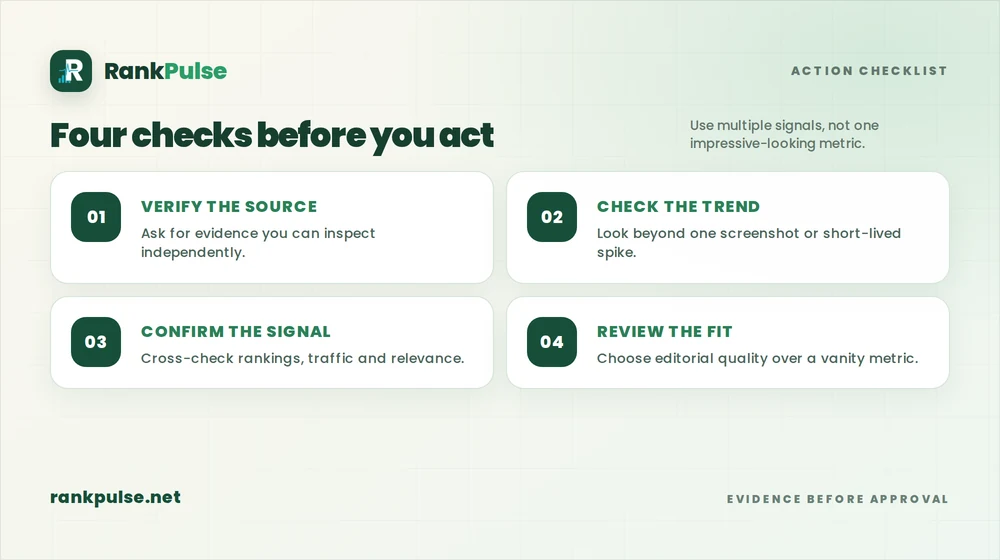
- Vet every site for real traffic patterns and editorial standards before committing; a cheap link from a fake-traffic site wastes your budget.
- Stay compliant with Google's spam policies by confirming publishers properly mark paid links with rel="sponsored" or rel="nofollow".
Why the First 90 Days Matter More Than the Next Two Years
Google updates its algorithm constantly. These broad changes roll out several times a year. Sites that bounce back fastest are those with natural, diverse, and relevant backlinks built over time.
New domains don't get a grace period. But they do get a window to build topical relevance before Google scrutinizes their link profile hard. In those first 90 days, you're not trying to rank yet. You're proving you're not spam.
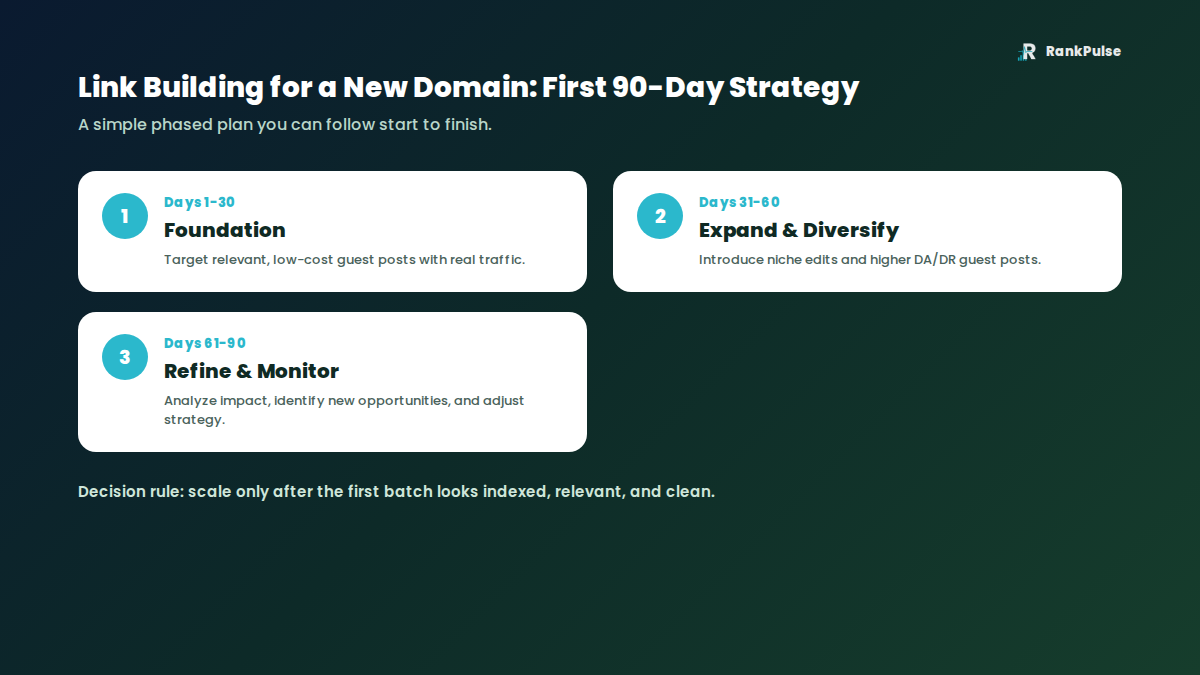
Here's a real path. A site launches with solid on-page content. By day 30, it has 3–5 relevant guest posts on publishers with actual traffic in the same vertical. By day 60, add another 5–8 placements, some from slightly higher-authority sites. By day 90, you've got a diverse mix—guest posts, niche edits, maybe one or two stronger links if your budget allows.
Quality Looks Different Than Most Link Sellers Claim
Domain Authority or Domain Rating alone don't equal quality. Neither metric tells you if a site is actually worth placing on.
A site with DA 60 can be completely off-topic for your niche and have fake traffic. You visit and find thin articles with comment sections full of spam.
Real quality has three parts. First, the traffic is genuine—not promised in a pitch deck, but actually measurable through public data or the publisher's own analytics. Second, editorial standards hold up. Read 10 articles. Most should help an actual reader. Third, the audience matches your customer.
We reviewed 550 publishers in our curated inventory. The median Domain Authority is 49 and DR is 63—but here's what actually matters: 83% charge $100 or less per post and get real traffic. That $100 gets you a real placement on a site real people read, not just a DA score.
Check typical link marketplaces. You'll see DA 70+ sites at $30. Those numbers don't make sense.
What to Actually Buy in the First 90 Days
Guest posts and niche edits. Period. Skip links in blog comments, private blog networks, and "PBN links" at $5 each. These link schemes violate Google's spam policies.
A guest post is content you write (or have written) and publish on a relevant site with a link in your author bio or within the article itself. It's transparent. The publisher usually marks it as sponsored. The reader gets value.
A niche edit happens when a publisher adds a sentence or two with your link into an existing article. Done well, it reads naturally.
Guest posts take longer. Niche edits are faster and cheaper. I'd split it this way: days 1–30, go 100% guest posts to build relevance. Days 31–60, mix in niche edits for speed. Days 61–90, run both and choose based on what's available.
That $60 median guest post price from our sample is real. Low end runs $30, high end $200. Niche edits typically cost 20–30% less than equivalent guest posts from the same publisher.
Two Real Examples of Sites Worth Placing On
A leading tech news site has Domain Authority 49, Domain Rating 81, and 130,000 monthly visitors. Guest posts run $120. The content is strong and genuinely relevant to tech and productivity niches. If you're in SaaS and this site fits your audience, that's a solid first buy.
A popular AI blog has DA 52, DR 77, and roughly 12,600 monthly visitors. Guest posts are $150. It focuses on AI with current, well-edited articles. If your product touches artificial intelligence, this beats a generic placement.
Neither is a "high DA" play. Both are solid mid-tier publishers with real traffic and editorial standards—exactly what works early on.
Staying Compliant With What Google Actually Requires
The gray area is paid links. Paid links aren't spam if they're marked with rel="sponsored" or rel="nofollow." Without that marking, Google treats them as ranking manipulation.
This doesn't ban paid links. It requires transparency. Before any placement, ask directly: "Will this link get marked rel='sponsored' or rel='nofollow'?" If they don't know what you're asking or say no, walk.
How to Measure What's Actually Working
Skip vanity metrics and rankings in your first 60 days. Measure referral traffic from placements instead. After a guest post on a leading tech news site or popular AI blog, check Google Analytics for referral traffic. A 130K-traffic site might send 20–50 visitors in the first week. A 12K-traffic site might send 3–10. That's real.
If a guest post sends zero traffic after a week, the article was weak, the placement was off-topic, or the publisher's traffic isn't genuine. Note it and adjust.
Brand mentions and search volume for your domain should tick up in Google Search Console by week 12. Not ranking yet. Just signs Google is indexing you and seeing links from multiple sources.
After 90 days, review everything: which placements drove traffic, which niche edits felt natural, which publishers were professional. Use that insight to double down on what worked in quarters two and three.
FAQs About New Domain Link Building
How many links should a new domain build in 90 days?
Aim for 8–15 unique placements across guest posts and niche edits. One placement per week is solid pace. Faster isn't better.
Is it okay to buy links for a brand-new website?
Guest posts and niche edits on real, editorially vetted publishers are standard practice and lower-risk if done transparently with proper rel="sponsored" or rel="nofollow" marking. Bulk link packages, private blog networks, and comment spam violate Google's policies.
What's the difference between guest posts and niche edits for a new domain?
Guest posts take more time and money but signal stronger expertise because you create new content. They feel more earned to Google. Niche edits are faster and cheaper because they fit into existing articles, but should still be relevant and not over-optimized.
How do I know if a site truly has real traffic?
Ask for third-party verification through Semrush, Ahrefs, or SimilarWeb, or request the publisher's own analytics. If they won't share, that's a red flag. Real traffic stays steady month to month. A spike that disappears usually means the numbers aren't real.
Should I aim for high-DA sites only?
No. A placement on a DA 50 site with genuine traffic and editorial quality beats a DA 70 site with inflated metrics and no real audience.
What happens if a low-quality link gets into my backlink profile?
One bad link on a new domain probably won't trigger a penalty. A pattern of bad links definitely can. That's why vetting matters. Every link should come from a site you'd recommend to a friend. Our guest posting service vets publishers before adding them to our system, so you're not rolling the dice on unknown sites.
How often should I audit paid links?
Audit paid links every quarter, and run a faster check after major ranking swings. Look at topical relevance, organic traffic trend, anchor text, outbound-link patterns, and the publisher's link policy before ordering more placements.
Are paid guest posts allowed by Google?
Google treats paid links that pass ranking credit as link spam unless they're properly marked where appropriate. Your due diligence should focus on relevance, editorial quality, disclosure policy, traffic, and reporting instead of assuming any placement is automatically safe.
What should I ask a link vendor before ordering?
Ask for the live domain, DA, DR, estimated traffic, sample URLs, content standards, price, turnaround, and link attributes before payment. A serious vendor will be comfortable showing the evidence before you sign off on a site.
Data note: Across a 550-site sample of our curated inventory, the median guest post price is $60. For detailed pricing and inventory options, visit our pricing page.
The first 90 days on a new domain aren't about gaming your way to rankings. They're about proving you're a real site with real content from real publishers. Get that foundation right, and everything else gets easier. For a deeper look at budget-conscious link building, see our guide to budget guest posting.

Level 2 Fiverr seller with a 5.0 rating. Has reviewed thousands of publisher records to build a curated placement inventory since 2024. Fiverr profile · zahid@rankpulse.net