- We looked at 6,739 publishers that offered paid guest posts by email, with Ahrefs and Semrush figures dated 7 November 2026.
- A high score is no promise of readers. Of 1,551 sites rated DR 50 or more, 30% get fewer than 1,000 organic visits a month, by Ahrefs' estimate.
- Seller traffic claims were a median 9 times Ahrefs' organic estimate, but only 1.4 times Semrush's total-visits estimate. Most sellers quote all traffic, not search traffic.
- Only 3.7% of offers said the link would be marked sponsored. Nearly a third said it would not be.
Domain Rating is a weak guide to whether a guest post site has real readers. In a list of 6,739 publishers that sell guest posts, the link between DR and organic traffic was only moderate. About 30% of the sites rated DR 50 or higher got fewer than 1,000 organic visits a month, by Ahrefs' estimate. The same list shows how far seller traffic claims drift from tool data, how rarely publishers say they mark paid links, and how few sites have a US or UK audience. Here is what we found and what it means before you buy.
About the data
The list holds publishers that replied to email outreach with a paid-post offer, and it reached RankPulse through a supplier partner in November 2026. Each row carries Ahrefs and Semrush figures dated 7 November 2026, plus the terms the publisher stated in writing. We removed two platform domains, a messaging service and a free blog subdomain, which leaves 6,739 sites.
Three limits matter:
- Only sites with some Ahrefs search visits are included. Sites with none were left out of the list, so the share of weak sites here is, if anything, too low.
- Visit figures are estimates. Ahrefs and Semrush model organic visits from rankings, search volume and click-through rates. They are useful for comparing sites, not as exact counts.
- This is a seller-side list. It describes sites that sell posts, not the web as a whole.
We publish only totals and shares. No publisher names, prices or contact details appear here.
Most sites in the list are small
The median site gets about 728 organic visits a month. More than half get under 1,000.
| Ahrefs organic visits a month | Sites | Share |
|---|---|---|
| Under 100 | 1,695 | 25.2% |
| 100 to 999 | 2,003 | 29.7% |
| 1,000 to 9,999 | 2,033 | 30.2% |
| 10,000 to 99,999 | 854 | 12.7% |
| 100,000 or more | 154 | 2.3% |
A small site is not a bad site. A focused blog with 800 real readers in your niche can be a better placement than a general site with ten times the visits. The point is to know which one you are buying.
DR and traffic only loosely agree
Median visits do climb with DR. But the spread inside each band is wide, and the rank correlation between the two is 0.47. That is a moderate link, not a reliable one.
| Ahrefs DR | Sites | Median organic visits | Under 1,000 visits |
|---|---|---|---|
| 0 to 19 | 1,598 | 91 | 84% |
| 20 to 29 | 1,133 | 456 | 64% |
| 30 to 39 | 1,399 | 921 | 51% |
| 40 to 49 | 1,058 | 1,613 | 42% |
| 50 to 59 | 822 | 2,456 | 36% |
| 60 to 69 | 402 | 4,128 | 29% |
| 70 to 79 | 279 | 9,755 | 20% |
| 80 and above | 48 | 27,528 | 17% |
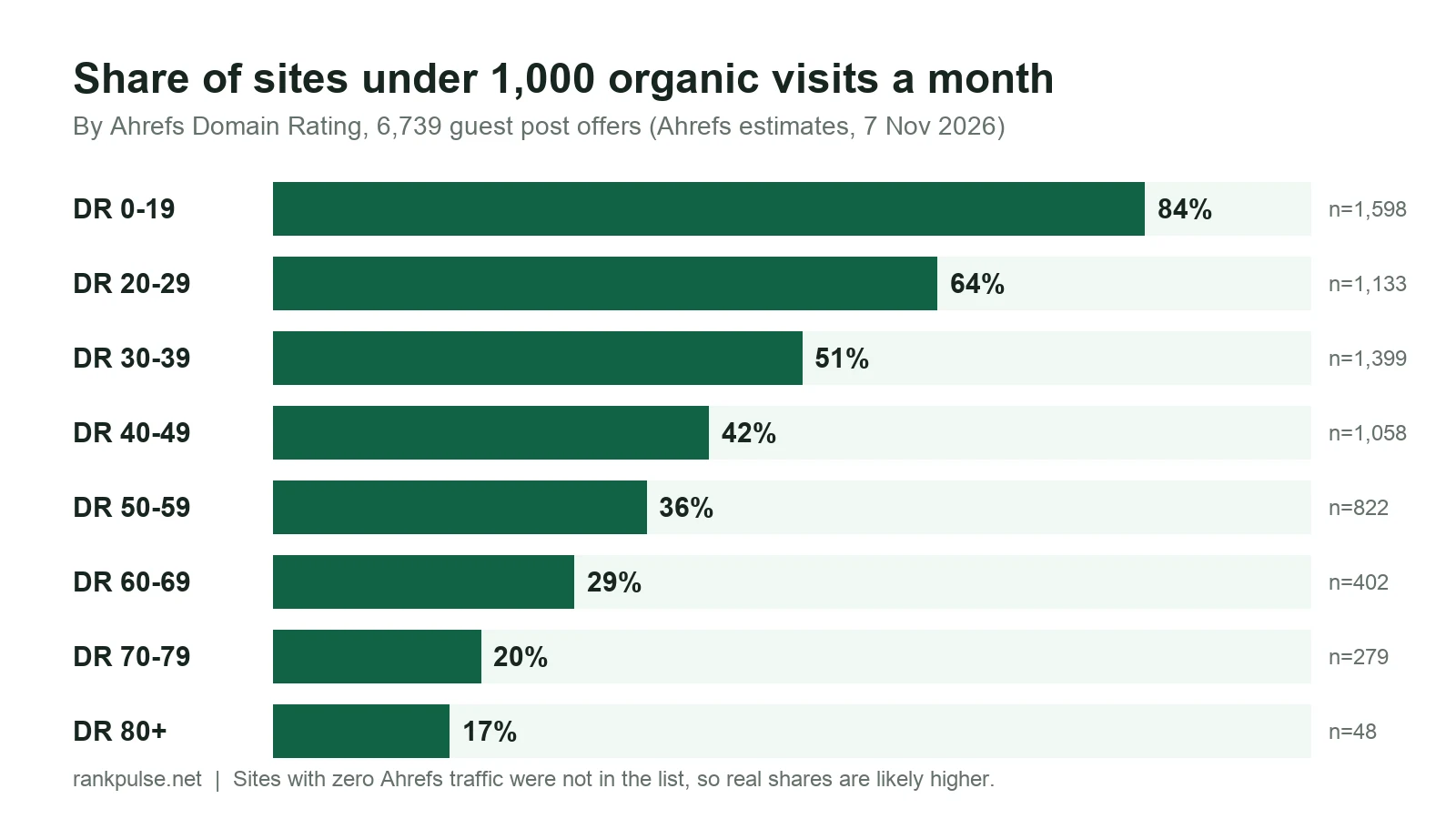
Across all 1,551 sites at DR 50 or more, 472 (30.4%) get fewer than 1,000 organic visits and 179 (11.5%) get fewer than 100. Even at DR 70 and above, one site in five falls under 1,000. Ahrefs builds DR from a site's backlink profile, so a site can collect links without ever winning search traffic. Our guide to what counts as a good authority score explains why the number needs context.
Seller traffic claims depend on which number they quote
In 142 offers the seller stated a traffic figure. Against Ahrefs' organic estimate, the claim was a median 9.1 times higher. About 75% of claims were more than double, and 48% were more than ten times.
Compare like with like and the gap shrinks. For 77 of those sites Semrush also had a total-visits estimate, which counts every channel, not just search. Against that, the median claim was only 1.4 times higher, and 44% of claims were at or below it. So most sellers are not inventing numbers. They are quoting all traffic, including direct, social and referral visits, while the buyer usually cares about search visitors.
Always ask which figure you are looking at and where it comes from. Our guide to traffic proof beyond screenshots lists the questions to ask.
Ahrefs and Semrush often disagree
111 sites had at least 100 monthly organic visits in both tools, and for those the two estimates were a median 2.1 times apart. They were within a factor of two for 42% of sites and more than five times apart for 12%. Semrush gave the higher figure 78% of the time. Both companies describe their organic numbers as models built on rankings and click-through rates, so this is expected. The practical rule: compare sites inside one tool, and treat a single number as a range.
Few publishers say they mark paid links
Google asks for paid links to be marked rel="sponsored", with nofollow also accepted. Its spam policies treat paid links that pass ranking credit as link spam. Here is what the offers said in writing:
| Statement in the offer | Sites | Share |
|---|---|---|
| Link will be marked sponsored | 252 | 3.7% |
| No sponsored tag | 2,137 | 31.7% |
| Not stated | 4,350 | 64.5% |
On link type, 4,035 offers (60%) promised a dofollow link and only 78 said nofollow. If you buy, ask how the publisher marks the link before you pay. Our guide to sponsored and nofollow on paid guest posts covers the trade-offs.
Only a quarter of sites have a US or UK audience
Ahrefs lists the United States as the top country by visits for 1,361 sites (20.2%) and the United Kingdom for 372 (5.5%). Germany (11.1%), France (9.6%), India (7.4%) and Italy (7.2%) follow. Audiences are also concentrated: the median site gets 92% of its organic traffic from its top country. A site's top country therefore tells you most of what you need about who reads it. See our guide to guest posting for US and UK audiences.
The same site is often sold by several sellers
For 1,040 sites (15.4%), at least one other seller in the list offered the same site. Resellers are not a problem in themselves. But it means two quotes for one site can differ, and the seller may not control the publishing terms.
What this means before you buy
- Check organic visits for the exact country you sell in, not DR alone.
- Ask which traffic figure a seller is quoting, organic or total, and from which tool.
- Compare sites inside one tool. Read every figure as a range.
- Get the link policy in writing, including how paid links are marked.
- Look at the page, not only the domain: recent posts, topic fit and whether Google indexes them.
Our 12-point vetting checklist turns these into steps.
How RankPulse uses these checks
We run the same checks on every site before we offer it: organic visits and their country, topic fit, spam signals and the publisher's link policy. You approve the exact site before anything is placed. See our guest posting service.
Frequently asked questions
Does a high DR mean a site gets real visitors?
Not reliably. In this list, 30% of sites rated DR 50 or more had fewer than 1,000 organic visits a month by Ahrefs' estimate.
Why do seller traffic numbers look higher than Ahrefs?
Sellers usually quote total visits from every channel, while Ahrefs estimates search visits only. Against Semrush's total-visits estimate, claims were much closer.
Which traffic tool is right, Ahrefs or Semrush?
Neither gives exact counts. Both model traffic from rankings, so compare sites inside one tool and treat each number as a range.
How many guest post sellers mark links as sponsored?
In these offers, only 3.7% said the link would be marked sponsored, and about a third said it would not be.
Sources
- Ahrefs Help: how organic traffic is calculated: organic traffic is an estimate from rankings, volume and CTR (accessed November 22, 2026)
- Ahrefs Help: what is Domain Rating: DR is based on a site's backlink profile (accessed November 22, 2026)
- Semrush Knowledge Base: how Semrush estimates organic traffic: organic traffic is a model, not a visit count (accessed November 22, 2026)
- Semrush Knowledge Base: Traffic Analytics vs Domain Analytics: total visits from all channels vs organic estimates (accessed November 22, 2026)
- Google Search Central: qualify your outbound links: rel="sponsored" and nofollow for paid links (accessed November 22, 2026)
- Google Search Central: spam policies: paid links that pass ranking credit are link spam (accessed November 22, 2026)