RankPulse Blog
Are Your Backlinks Really Indexed by Google?
Your Backlinks Are Live, But Are They Actually Indexed?
You paid for a backlink, got the screenshot to prove it's live, checked it three times. Then your organic traffic stays flat. A live backlink and an indexed backlink are not the same thing. Google might see the page, but never crawl or index that specific link. You're paying for a link that's essentially invisible to the algorithm.
- A live link doesn't mean Google indexed it for ranking value. Check indexation status in Search Console and with
site:operators. - After Google's recent spam updates, unindexed backlinks are more common on sites with low editorial quality or crawl limits.
- Vetted inventory with real traffic, decent domain metrics, and actual content value reduces the risk of your links sitting invisible.
- Transparent link pricing (with many options under $100, and a median of $60 for guest posts in vetted networks like ours) beats cheap bulk packages that often hide indexation problems.
Source note: For Google policy or update references, this article uses Google documentation and treats unsupported update-target claims as audit guidance, not confirmed targeting.
Recent Google spam updates made this problem significantly worse. Low-quality sites, thin content, and pages with crawl-budget issues started seeing fewer backlinks actually indexed. If your link ended up on one of those pages, you're funding someone else's website traffic, not your own rankings.
Why "Live" and "Indexed" Are Two Different Things
A live backlink means the HTML code is on the page. Google's crawler found it. But indexation is what matters. It means Google crawled the page, added it to the search index, and treated the link as a signal. The crawler processes the page first. Then extraction and indexing happen next. In theory, Google crawls your guest post within days and it enters search results. But here's the catch: your backlink might not be indexed as a ranking signal if the host site has crawl-budget constraints, low authority, spam signals, or thin content.
Google confirmed its spam updates are designed to combat various types of spam. Sites that host lots of low-quality guest posts, affiliate content, or keyword-stuffed pages now face tighter crawl limits. Your backlink lands on one of those sites, and it's treated as a second-class signal, if at all.
How to Verify Your Backlinks Are Actually Indexed
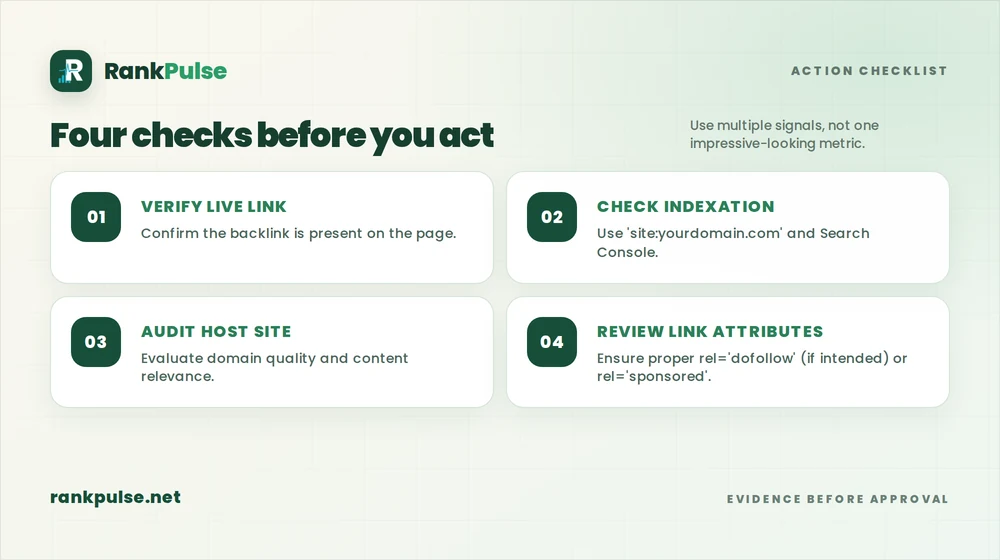
Start with the basics. Search for the exact URL of the page hosting your backlink in Google Search Console. Look for the "Discovered, not indexed" status. That's a red flag—Google found the page but didn't add it to the searchable index. Your link is on that page. It's not being counted.
Use the site: operator in Google. Type site:example.com where example.com is the host domain. If you see the page in results, it's indexed. That's step one. Step two: click through and manually verify your link is there. It's tedious. It's necessary.
Google Search Console's "Coverage" report is your best friend here. Filter for "Valid" pages. Then cross-reference those URLs against your backlink portfolio. If your link host isn't in the "Valid" list, or shows as "Crawled, not indexed," you've got a problem. Google won't be passing ranking credit through that backlink.
Tools like SEMrush, Ahrefs, or Moz can tell you if a backlink is recognized, but they're sampling Google's data, not pulling live indexation status. They're useful for trends. Search Console is the source of truth.
Why Your Backlinks Might Not Be Indexed
Low domain authority alone doesn't explain it. We've worked with sites in the DA 30-50 range that maintain solid indexation because they produce real editorial content and get organic traffic. The problem isn't the number. It's the quality of the site and its surrounding content.
- Crawl-budget limits: Google allocates crawl budget based on site authority and update frequency. A site that publishes dozens of guest posts a day with thin unique content uses up its budget fast. Your page gets crawled once and never revisited for index updates.
- Nofollow attributes: If your backlink carries
rel="nofollow", it's still indexed, but it doesn't pass ranking credit. Some hosts blanket all guest post links with nofollow to comply with Google's paid link policy. That's fine if it's disclosed. It's dishonest if you paid for a dofollow link. - Thin or spammy surrounding content: Google indexes pages, not just links. If the page your link sits on has low word count, keyword stuffing, or obvious affiliate bloat, the whole page gets flagged. The indexation signal cascades down to your backlink.
- Recent spam update penalties: Google's spam updates are designed to target various types of spam. Sites running high-volume guest post operations without editorial oversight started seeing indexation drops. Your link gets caught in that wave.
What Vetted Inventory Actually Means
Real vetting means checking three things: domain metrics, organic traffic, and editorial quality. Numbers alone don't tell the story. We audit for real traffic, content relevance, and natural link placement. Across our 550-site inventory, the median Domain Rating is 63 and median Domain Authority is 49—but price and traffic matter more. 83% of sites in our inventory cost $100 or less.
The result is lower risk. You're not buying a lottery ticket. You're buying a link on a site that Google already treats as part of the searchable web.
The Real Cost of Unindexed Backlinks
An unindexed backlink is money wasted. You paid for ranking value but got only a vanity metric that shows up in backlink reports without delivering any algorithmic value to Google. The link exists on the page, but if Google never indexed the page or extracted the link for its ranking algorithm, the investment yields nothing.
Worse, bulk link packages often bury this. They promise 100 backlinks, deliver 100 live links, and never mention that 30 of them ended up on unindexed pages. The seller reports success because the metric was "live links," not "indexed links." By the time you notice your traffic hasn't moved, the seller's refund window is closed.
Vetting isn't just about avoiding waste—it's about building a sustainable backlink profile. Google values consistency, and a link on a site that stays indexed and gets crawled tells the algorithm something real about your content. A link on an unindexed page tells it nothing.
How Long Until Google Indexes a Backlink?
This depends on the host site's crawl frequency and your own site's authority. Google often crawls new pages within 24-48 hours if the site has good domain authority and fresh content; smaller sites may wait a week or two. Indexation usually follows within days.
The practical timeline: give it two weeks. Check Search Console in week three. If the host page shows as "Valid" and your link is live when you visit it, you're good. If it shows "Discovered, not indexed" or your link vanished, escalate with the seller. Legitimate link providers stand behind their placements.
Why Does Relevance Matter for Indexation?
Relevant sites get crawled and indexed faster than random topical matches—that shouldn't matter to Google's algorithm, but it does. The crawler prioritizes high-traffic, high-authority sites and crawls cohesive content clusters faster. A tech blog covering your software category will index your link quicker than a generic business listicle.
Relevance matters for more than ranking—it affects crawling and indexation mechanics. A relevant site gets better crawl coverage, which means your link gets extracted and indexed as part of the normal algorithm cycle.
The Post-Update Reality
Recent Google core updates and spam updates changed how Google treats bulk link sources. Sites that host high volumes of guest posts or sponsored content now face stricter scrutiny. Some saw indexation rates drop by 20-40%. If you're still buying from unvetted bulk networks, you're buying links on sites that are slowly being deprioritized by Google's algorithm.
That doesn't mean guest posting is dead. It means quality matters more. A single link on a vetted, indexed site with real editorial standards beats ten links on sites sliding into "discovered, not indexed" limbo. Check your current backlink portfolio and run each link host through Search Console to see which pages are valid and which are orphaned from the index.
Frequently Asked Questions
Can a nofollow link still be indexed?
Yes. The rel="nofollow" attribute tells Google not to pass ranking credit through the link, but it doesn't prevent indexation. The page can be indexed, and the link can be visible. It just doesn't count as a ranking signal. If you paid for a dofollow link and got nofollow instead, that's a breach of contract, not a technical issue. Legitimate link sellers use nofollow only when required by Google's spam policies, typically for paid placements or affiliate links.
What if my backlinks get de-indexed after months?
It happens. The host site either got flagged by a spam update, lost crawl budget due to site-wide issues, or the page was manually removed from the index. De-indexation is usually a host-site problem, not your fault. But it means you've lost the ranking value of that link. Good link providers monitor this and either replace the link or offer a refund. Poor ones disappear. Ask about replacement guarantees before you buy.
How do I know if a link seller is hiding unindexed links?
Ask them for a list of past placements with the exact host URLs. Then check those URLs in Search Console yourself. If they dodge the request or the URLs don't exist, or if you find that 30% of them show "Discovered, not indexed," you've got your answer. Transparent sellers show indexation status alongside domain metrics in every placement report.
Is it worth buying links on lower-authority sites if they're indexed?
It depends on relevance and risk. A site with DA 35 but solid organic traffic, relevant content, and clean indexation is worth more than a site with DA 55 that's mostly unindexed guest posts. We have 37% of our inventory at DR 70+, but we also work with strong sites in the DR 50-69 range because they have real traffic and consistent indexation. The question isn't the number. It's whether Google treats the site as a real, trusted source in your niche.
How often should I audit my backlink indexation?
Quarterly is the minimum. Pull your backlink report, extract the unique host domains, and spot-check them in Search Console. If you notice a cluster of them showing "Discovered, not indexed," investigate that link source. Once every six months, do a full audit. It takes an hour and tells you whether your link-building investment is actually working or just sitting in a graveyard of unindexed pages.
What does "DA is Moz's metric, not Google's" mean for link vetting?
DA is Moz's proprietary metric, not Google's. Use it to shortlist potential host sites, but the real test is organic traffic trend, topical relevance, and whether Google actually indexes the pages. A site with DA 45 but strong indexation and real traffic often outperforms a site with DA 60 that's mostly unindexed guest posts.
Disclosure: RankPulse sells guest post placements on vetted publisher sites. Paid links are a paid link under Google's policies. Our focus is on vetting for editorial quality, real traffic, indexation stability, and transparent metrics, which reduces risk in your link-building program. Learn more about our placement service or explore the true cost of guest posting.
FAQ
Are paid guest posts allowed by Google?
Google treats paid links that pass ranking credit as link spam unless clearly disclosed. Buyer due diligence should focus on relevance, editorial quality, traffic, and transparent reporting—not on vendor promises of automatic safety.

Level 2 Fiverr seller with a 5.0 rating. Has reviewed thousands of publisher records to build a curated placement inventory since 2024. Fiverr profile · zahid@rankpulse.net